
Right or wrong, it’s very pleasant to break something from time to time.
Fyodor Dostoevsky

This is a chapel in St. Gallen, Switzerland called St. Mangen. Though the abbey and library of this town are the big tourist destination, it’s actually this little church that claims the title of oldest church in St. Gallen. Having been built so long ago (898, to be exact), you can imagine that this church has had to receive many extensive renovations. With every fault that developed in the building throughout the centuries, it was redone according to the needs of the congregation using new technological advances. Being in St. Mangen taught me something important: destruction is just as crucial in religion as creation.
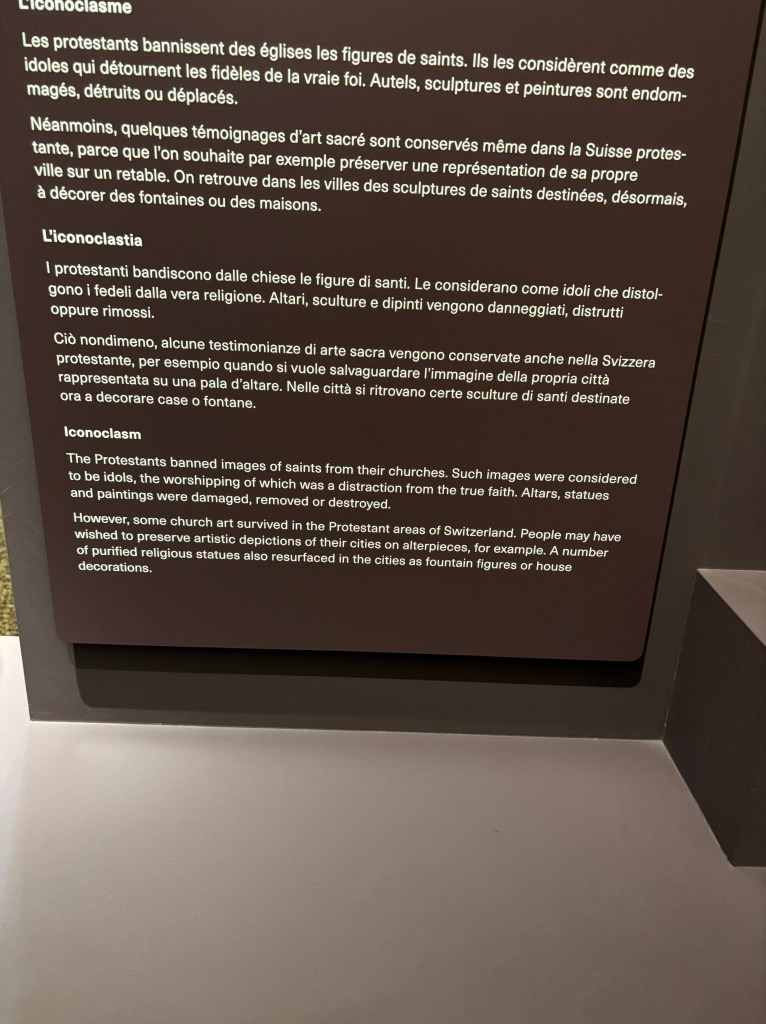
Having spent so much time in Germany and Switzerland recently, I’ve learned a lot about the destruction caused by the Protestant Reformation. In an effort to simplify the Catholic Church, many Protestants destroyed religious images, removed decadent decor, and remade chapel spaces to be simple and devout. To them, their destruction of images and art, also called iconoclasm, was an important way to express their faith. Further information can be found on the picture I took on the plaque below, found in the “History of Switzerland” exhibit at the Swiss National Museum.
I’ve been having a lot of thoughts about iconoclasm lately. I would love to lead you through them with a theoretical scenario.
Martin is a Lutheran who wants to show his devotion to God. He feels that he has been called to do this by destroying a Catholic statue created by his Catholic neighbor, Leo. However, Leo feels that he has been called to show his devotion to God by creating this statue.
Should Martin destroy the statue?
This simple scenario brings up a lot of religious questions (none of which I claim to have the answer to). Is either Martin’s or Leo’s calling more valid than the other’s? If so, which one, and why? What do you do when the divine calls you to destroy? Who is in the wrong, and who is in the right? The list goes on.
In this simplified scenario, I would personally say that Martin shouldn’t destroy the statue because it is not his place. Whether or not you take religion into account here, human beings can’t go around destroying each other’s property without intending to make amends. Martin’s beliefs are completely valid, but his religious actions shouldn’t annul Leo’s rights to control what is his.
Broadening our perspective to the iconoclasm of the Protestant Reformation complicates things. Many Protestants may have felt forced to be Catholic; is it alright for them to destroy this art as part of their protest and emancipation? If the objects in their churches didn’t inspire spirituality for them, did they have the right to get rid of them? Again, the questions are endless.
I think that it’s normally impossible to label iconoclasm as all “good” or all “bad.” In the case of the Reformation, there are many perspectives and ideas that you can argue either way. This remains true for most religious iconoclasm throughout time (except for in instances of complete malicious intent).
Instead, I think it’s better to label iconoclastic events as important in religious history. Both the creation and destruction of a piece of religious art can tell us about religious attitudes of the time.

This is a picture of me effectively “destroying” part of the beauty of this stained glass window. Because of my silhouette, other viewers don’t get to enjoy the full picture that I get to see. However, my being there creates a new experience for others around me. My “destroying” the art has provided a new and notable perspective.
I would love to hear your thoughts: in your opinion, should creation or destruction be more important in spirituality?
Iconoclasm
“Iconoclasm refers to the destruction of images or hostility toward visual representations in general.”
“Iconoclasm.” Lumenlearning.com. (https://courses.lumenlearning.com/suny-arthistory1/chapter/iconoclasm/)
Roman Catholicism
Prominent Christian branch. Begun during the Apostolic Age of Christianity, soon after the death of Jesus Christ. Over time, the bishop of Rome became the most powerful leader in this church. Many councils met over time to determine doctrine and clarify beliefs. Great Schism of 1054 led to separation between Catholicism and Eastern Orthodoxy. Protestantism split off of Catholicism. Beliefs include sacraments, the authority of scripture and tradition together, and that the Catholic Church is the one true church.
“Is Catholicism a Branch of Christianity?” Christianity.com. (https://www.christianity.com/church/denominations/what-is-catholicism.html)
Lutheranism
Major branch of Christian Protestantism. Based in doctrine first presented by Martin Luther (1483-1546) in an attempt to reform the Roman Catholic church. Focus on grace, faith, scripture, and preaching.
“What is Lutheranism?” Hope Lutheran Church. (https://www.hopelutheran.ca/about/what-is-lutheranism)
 Hallow
Leave a comment