
The Dunning-Kruger effect occurs when a person’s lack of knowledge and skill in a certain area causes them to overestimate their own competence. By contrast, this effect also drives those who excel in a given area to think the task is simple for everyone, leading them to underestimate their abilities.
The Decision Lab (https://thedecisionlab.com/biases/dunning-kruger-effect)
A concept that has fascinated me ever since I learned about it is the Dunning-Kruger effect. I’m no psychologist and definitely don’t understand this effect and its implications fully, but I have seen things like it in my own lived experience. From my understanding, this effect is a bias of the mind. It’s when someone who is just a beginner in a topic overestimates their abilities, thinking they’re something of an expert. On the flip side, experts might sell themselves short because they are more able to see just how little they know and understand.
I’ve seen myself on both sides of this effect. I think of my freshman year philosophy class at BYU, where on the first day, I assumed that I had an overall grasp on what we were talking about; throughout the rest of the semester, I realized that I knew little to nothing about the topic and was eager to learn more. I saw myself on the other side when I served as a missionary for my church. Though I felt I didn’t know much about our unique book of scripture, the Book of Mormon, I realized by teaching others that I knew much more than I thought.
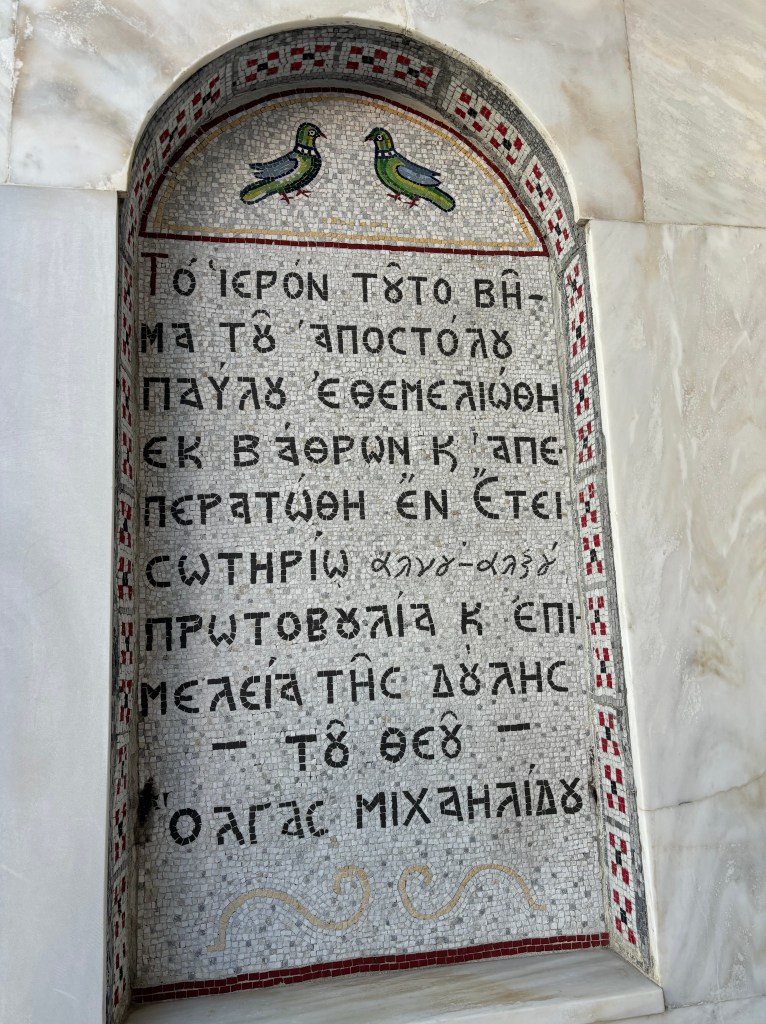
I’ve been considering how this plays into religious experience. I visited the Greek town of Verea, which is referred to as Beroea in the New Testament. Paul the Apostle visited this town during his missionary travels in Greece, and unlike other cities on the coast, the people in this town listened to him. Though this village is small and easy to pass through quickly, those who lived here are described as some of the most faithful groups in Christian scripture. They listened to Paul, but more than that, they turned to scripture and compared it to what they already believed. When they found it consistent, many people of Beroea faithfully converted to Christianity.

Hearing their story, as well as visiting their outdoor altar dedicated to the Apostle Paul, reminds me of the Dunning-Kruger effect. The people of Beroea weren’t new to faith, so Paul’s words weren’t the first religious teachings they had ever received. Because of their background and expertise, they didn’t jump blindly into a new faith. Additionally, they realized that even their lifelong knowledge fell short, and they desired more. Turning to the scriptures they already knew were right, they were able to gain more knowledge and travel further along their faith journey.
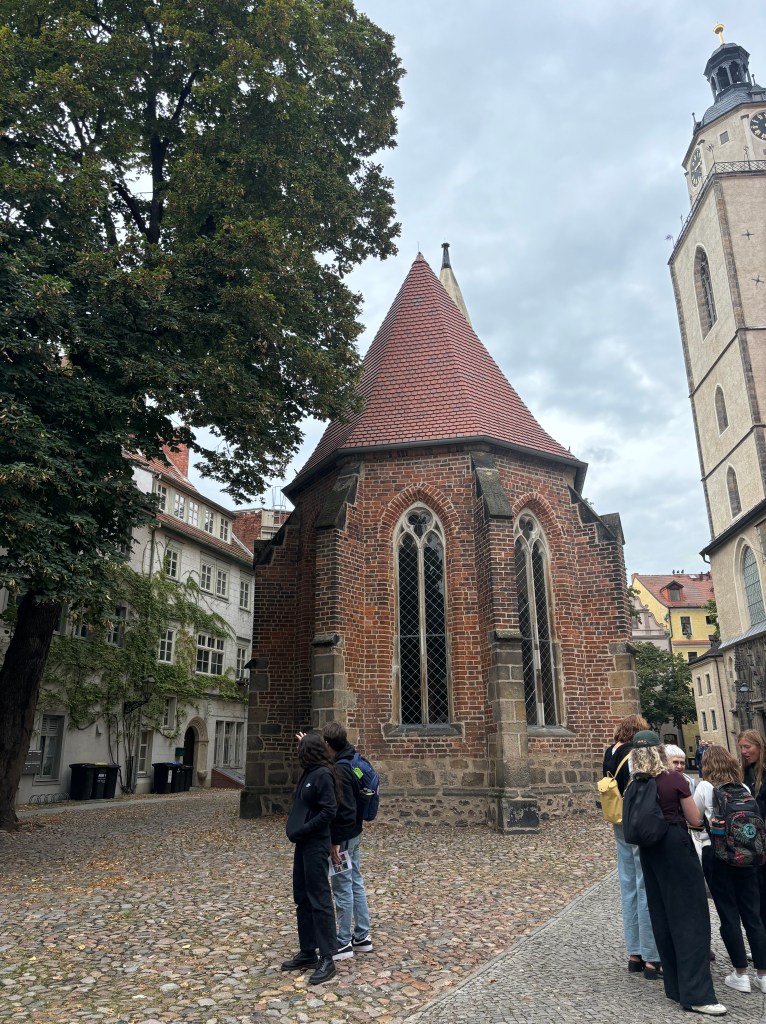
Many religions and religious practices put a lot of emphasis on remembering that you know very little. I think of Martin Luther when he decided to protest against Catholicism, not because he thought he was right, but because his readings in the Bible were directing him to do so. This small chapel in Wittenberg, Germany (pictured below) is where he explained biblical passages to smaller groups. To this day, Lutheran preachers and practitioners gather here to remember the importance of trusting God over themselves.
Jewish believers also emphasize truth over opinion. It’s a common practice amongst Jews to argue over the Word of G-d, not to prove themselves right, but to help all involved reach a more correct interpretation. This practice is a huge example of humility to me, showing that the truth matters above all else.
The picture below is from the floor of one of the synagogues in Venice’s old Jewish ghetto. Here, one black tile was intentionally placed outside the simple pattern. This is a symbol to all who visit this place that the hands of man can never create anything perfect. G-d alone can understand perfect truth, and it is our job to try to find that by any means possible.

It’s not always easy to be reminded that you don’t know everything. I hate that experience because it makes me feel stupid and silly. However, I’ve always wound up grateful, because it allows me to learn and actually get closer to where I thought I was originally. By realizing I don’t know that much, I learn more and come closer to the truth.
What are the most important truths you’ve learned in your life? How did you learn them?
The Book of Mormon
“The Book of Mormon takes place in the ancient Americas and, like the Bible, was written by Jesus Christ’s followers. It teaches His gospel and testifies of Him. As you live the teachings found in the Book of Mormon, you can find peace and truth.”
“The Book of Mormon.” Come Unto Christ. (https://www.churchofjesuschrist.org/comeuntochrist/believe/book-of-mormon)
The New Testament
“The New Testament is the second half of the Christian Bible…The New Testament contains 27 books written in Greek by 15 or 16 different authors between 50 C.E and 120 C.E. It can be divided into 4 groups: Gospels, Acts of the Apostles, Epistles, and Apocalypse. The New Testament contains 4 Gospels: Matthew, Mark, Luke, and John. These books tell the stories about Jesus’ life, ministry, and death…Acts of the Apostles, written by the author of the third Gospel (“Luke”), describes the spread of the Christian church from Jesus’ death to the death of the apostle Paul. Following Acts are 21 epistles or letters. Most of these New Testament books are records of correspondence between a church leader and a Christian community; the New Testament epistles address issues of Christian belief, practice, and ethics…The last book in the New Testament is Revelation, a Christian apocalypse. The author of this book, John, describes the events leading up to the destruction of this world and the appearance of the world to come.”
“Chapter 01 – What Is The New Testament?” Oxford University Press. (https://global.oup.com/us/companion.websites/0195161238/studentresources/chapter01/)
Saint Paul the Apostle
“St. Paul, was probably born ten years later than Jesus. The place of his birth was Tarsus, a cosmopolitan city in southern Turkey. He was a Jew and a ‘Roman Citizen’, meaning that he spoke ‘Koine’ Greek, the household language of all educated citizens throughout the Roman empire. Well-educated, he was sent in his late teens to Jerusalem to be instructed in Judaism under the guidance of the eminent Rabbi Gamaliel. Paul, then known as Saul, became a respected Pharisee and understood the danger of the new movement arising from Jesus. He gave himself to eliminating it. While journeying to Damascus, he had an overwhelming experience which rendered him a powerful advocate of Christianity. He took the faith from out of its Jewish confines and planted it within the non-Jewish world. Travelling extensively, he came to Greece, planting churches in Philippi, Thessalonica, Athens, Loutro Elenis and Corinth and is known to have visited Veroia and Crete…Paul kept in contact with the churches he planted by writing letters, some of which are in the New Testament…They are ‘applied Christianity’ rather than ‘systematic theology’.”
“Paul the Apostle.” St. Paul’s Anglican Church Athens. (https://anglicanchurchathens.gr/history-team-st-pauls/paul-the-apostle/)
Martin Luther
1483-1546. German monk, theologian, and reformer. “As a young monk, Martin Luther doubted and despaired of his faith. He found the redeeming message in the Bible. However, his knowledge contradicted the ecclesiastical doctrine of the time and the theologian Luther clearly expressed his criticism. In 1517 he published his 95 theses against the trade in [indulgences] and wanted to stimulate a reform of his church. The movement he thus triggered took over not only church life, but also all areas of society. Today, Martin Luther is world famous as the reformer and founder of Protestantism.”
“Martin Luther.” Evangelische Kirche in Deutschland. (https://www.ekd.de/Martin-Luther-10870.htm)
Roman Catholicism
Prominent Christian branch. Begun during the Apostolic Age of Christianity, soon after the death of Jesus Christ. Over time, the bishop of Rome became the most powerful leader in this church. Many councils met over time to determine doctrine and clarify beliefs. Great Schism of 1054 led to separation between Catholicism and Eastern Orthodoxy. Protestantism split off of Catholicism. Beliefs include sacraments, the authority of scripture and tradition together, and that the Catholic Church is the one true church.
“Is Catholicism a Branch of Christianity?” Christianity.com. (https://www.christianity.com/church/denominations/what-is-catholicism.html)
Lutheranism
Major branch of Christian Protestantism. Based in doctrine first presented by Martin Luther (1483-1546) in an attempt to reform the Roman Catholic church. Focus on grace, faith, scripture, and preaching.
“What is Lutheranism?” Hope Lutheran Church. (https://www.hopelutheran.ca/about/what-is-lutheranism)
Synagogue
Center of Jewish worship; many Jews these buildings as the center of their religious lives. Traditionally, men and women are seated separately (though this isn’t uniform in all Jewish sects today). Has a shrine to house the synagogue’s Torah scrolls; many other features are uniform across all synagogues and all serve to point the worshiper to G-d.
“What Is a Synagogue?” Chabad.org. (https://www.chabad.org/library/article_cdo/aid/365930/jewish/What-Is-a-Synagogue.htm)
Ghetto
“A quarter of a city especially in Europe in which Jews were formerly required to live.”
“Ghetto Definition & Meaning.” Merriam-Webster. (https://www.merriam-webster.com/dictionary/ghetto)
 Hallow
Leave a comment