
“Earth” without “art” is just “eh.”
Common saying
I had a really interesting conversation with my friends Dallyn and Addi the other day as we made our way around Meknes. Dallyn is working on a project where he’s analyzing the way different religions use art, and he asked me and Addi for our perspectives on that thought. This will be just a vague collection of some of the thoughts that were shared.
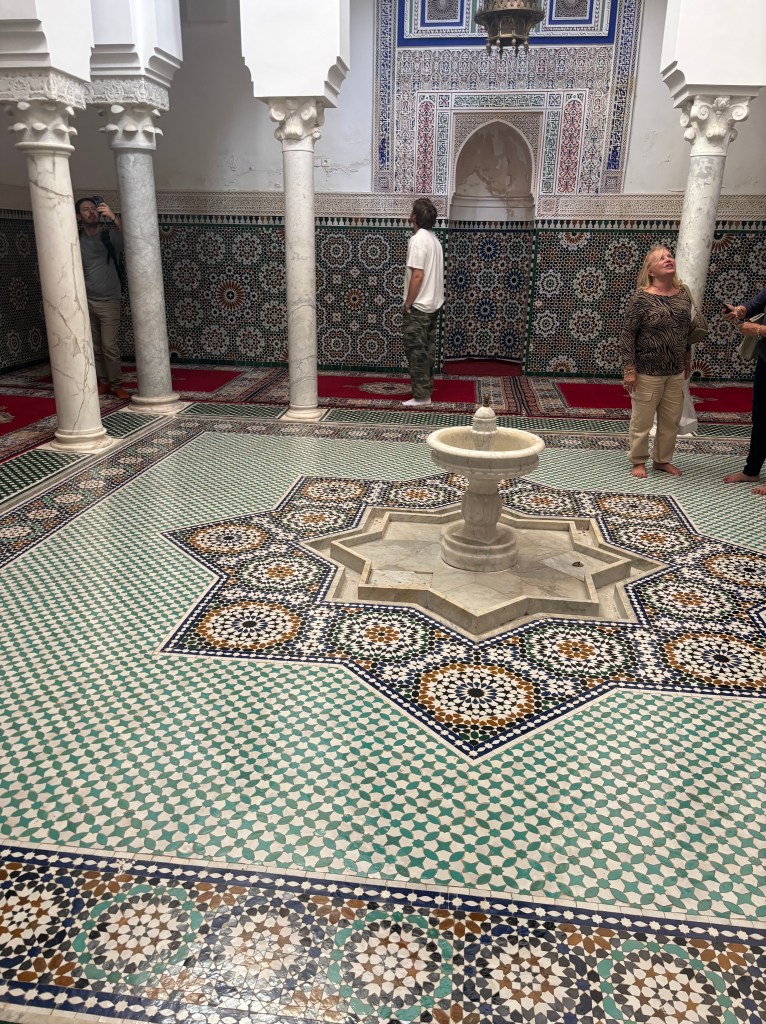
The art that I’ve seen in mosques is much different than I’ve seen in cathedrals. Then, the art I’ve seen in some mosques differs greatly from art I’ve seen in different mosques. Between any church, temple, cathedral, synagogue, mosque, or other holy place that you might visit, the artistic expression will change. Of course, different artists work on these different places, explaining much of why each space isn’t exactly alike. But you can tell a lot about intention, belief, and ideology of both an artist and a religion from the art selected for a sacred space.
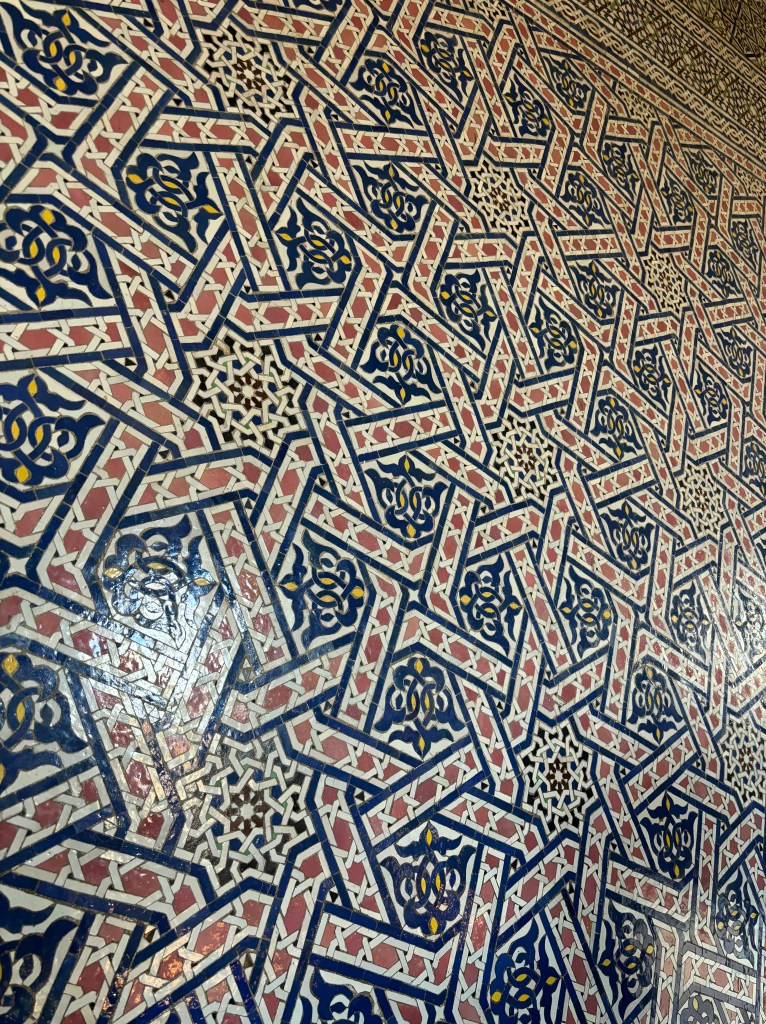
One of the most striking identifying features of a mosque is its lack of artistic depiction of living creatures. Where a cathedral typically uses multiple depictions of Jesus Christ, Biblical figures, and saints to adorn its walls, a mosque will show no one. This isn’t because they don’t think of their leaders and examples highly; in fact, you could probably claim the exact opposite. Allah isn’t depicted in art because Allah doesn’t have a body like we do, so our artistic attempts to capture Him will always fall miserably short of what it should be. Then, important figures like the Prophet Muhammad (PBUH) aren’t depicted because people shouldn’t be venerated before Allah. So, mosques will typically use very thought-out geometric designs to cover their walls.
The intention of a geometric design is much different than a painting of a Bible story, the unvoweled name of G-d, or a statue of the Hindu God you devote yourself to. From my experience alone, I felt that a mosque’s geometry was intended to teach me about Allah in a different way. When you look at these designs, it’s easy to be lost in the pattern. The colors almost move. It takes you out of the normal world of forms and functions and weaves you into an intricate tapestry that can’t be understood unless you stand a few steps back from it.
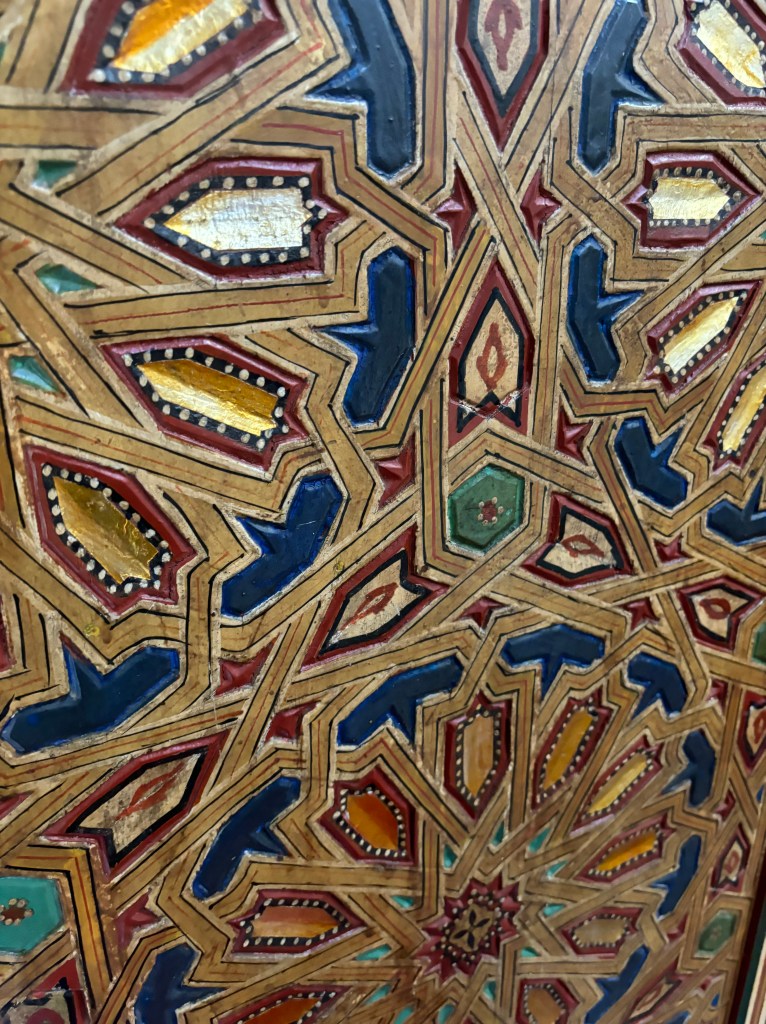
A painting of a Biblical account may be there to teach you a story, or to remind you of something you already know. When a Christian sees a depiction of Jesus Christ on the cross, it reminds them of a story they know while evoking emotions like grief and awe. Deep contemplation is usually intended in art like this as well, but in a much different way. In a piece like this, you contemplate an exact moment or person. In Islamic geometry, your aim of contemplation isn’t that set in stone.
I don’t know too much about religious art, but I’ve loved observing it over the course of my pilgrimage. I hope my meager thoughts will be enough to spark more of your own!
If you were going to make a piece of spiritual art, what would you create?
Mosque/Masjid
“The Mosque is considered to be the community center for Muslims. Better known in Arabic as a Masjid, the mosque represents the nucleus of the Muslim family and community. Daily prayers are offered five times throughout segments of the day. After prayers are offered, Muslims gather for brief discussion and interaction with one another. This interaction maintains a level of unity in the community by fostering social, spiritual, and economic bonds. On Friday afternoons, Muslims hold their weekly congregational prayer known in the Arabic language as Jummah, which means congregation. This weekly ritual provides the Muslim community the opportunity to be reminded and encouraged to live a virtuous life, and to have a positive impact to improve the society and environment in which they live. The message is delivered by the Imam of the Mosque.”
“What is a Masjid.” Islamic Society of Central Florida. (https://iscf.org/masjid/what-is-a-masjid/)
Cathedral
“A cathedral is the seat of the bishop and a centre of worship and mission. The primary purpose of a cathedral is to be a place of Christian worship but it is also often the oldest building in continuous use in its surrounding area and of significance to the heritage, culture and community life of the area it serves.”
“What is a cathedral?” The Association of English Cathedrals. (https://www.englishcathedrals.co.uk/about-us/)
Synagogue
Center of Jewish worship; many Jews these buildings as the center of their religious lives. Traditionally, men and women are seated separately (though this isn’t uniform in all Jewish sects today). Has a shrine to house the synagogue’s Torah scrolls; many other features are uniform across all synagogues and all serve to point the worshiper to G-d.
“What Is a Synagogue?” Chabad.org. (https://www.chabad.org/library/article_cdo/aid/365930/jewish/What-Is-a-Synagogue.htm)
Jesus Christ
Founder and leader of all Christianity. Believed to be the Son of God. Born in Bethlehem around 6-4 BCE. Son of the Virgin Mary. Died around 30 BCE in Jerusalem. The New Testament focuses on Him and His Gospel (meaning His teachings). Teachings focus on honoring God, loving others, the kingdom of God, etc. Performed many miracles. Was captured by the Jews and crucified by the Romans. Believed to have resurrected three days after His death.
“Jesus.” Britannica. (https://www.britannica.com/biography/Jesus/The-relation-of-Jesus-teaching-to-the-Jewish-law)
Prophet Muhammad (PBUH)
570-632 CE. Born in Mecca. “The Prophet Muhammad is both a messenger of God and a personal role model for Muslims…One night during the month of Ramadan, Muhammad reported having a strange encounter [with the angel Gabriel] while half-asleep in a cave [where he was commanded to recite]…Muhammad continued to receive revelations from God in Medina, and the message spread…Most Muslims are careful to insist, however, that “Muhammad is no more than a messenger” (Qur’an 3:144), and not a divine being. When Muslims refer to the Prophet Muhammad, to show reverence, his name is often followed by the phrase “salla llahu alayhi wa sallam” meaning “May the prayers and peace of God be upon him.” In writing, this may be abbreviated as (sa), SAW, or PBUH meaning “peace be upon him,” while in other cases the calligraphic Arabic form is written.”
“Muhammad: The Messenger of God.” The Pluralism Project, Harvard University. (https://hwpi.harvard.edu/files/pluralism/files/muhammad-_the_messenger_of_god_4.pdf)
Hinduism
Also called Sanatana Dharma. Some consider it to be the world’s oldest religion. Indigenous religion of India and surrounding areas (in fact, “Hindu” truly refers only to a person that lives in this area, rather than someone that follows Sanatana Dharma). Came into being when the Dravidians interacted with the native people in this area. Written canon are the Shruti and the Smriti. Believe in reincarnation, gods, karma, and Nirvana (meaning release from the wheel of reincarnation and rejoining Brahman). No central leadership or required orthodoxy.
“Hinduism Basics.” Hindu American Foundation. (https://www.hinduamerican.org/hinduism-basics)
 Hallow
Leave a comment