
That might be what you’d refer to as a “Sikh” day. Or, perhaps you could say that today, we were truly “Sikh”ing the sacred.
Grant Underwood
From Türkiye, I flew to India, a country I never thought that I’d visit. It’s been incredibly fun and incredibly difficult to be here; the air quality is even worse than you’d expect, and the food is a thousand times better than you’d expect (unless you get food poisoning, then it’s not good). But, the religious significance of this country is second to no other. Here, major religions such as Hinduism, Buddhism, Jainism, and Sikhism began. Truly, India has and will continue to impact the entire world forever.
The first religious site that I was able to see in India was the Golden Temple of Amritsar. As one of the axis mundis of the Sikh world, I was one of at least a hundred thousand other pilgrims that day, yet my experience was personal and profound. I want to share just a few aspects of my visit that stood out to me during my visit to this holy site.
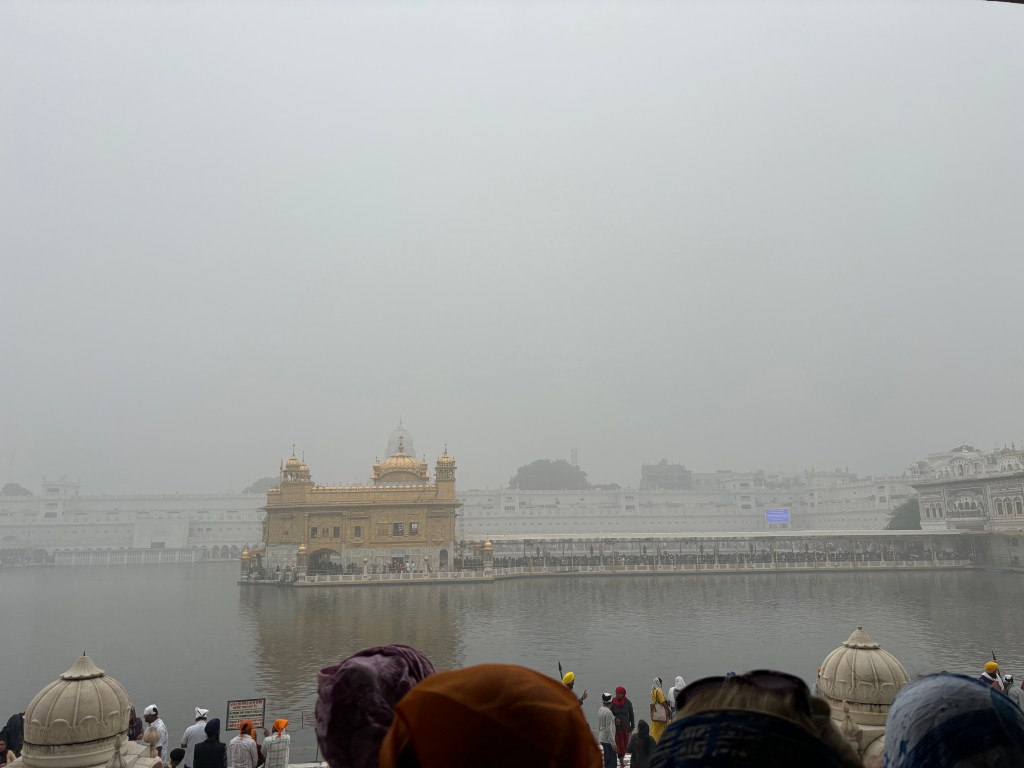
Your visit to the temple begins outside the enclosure’s walls, where you take off your shoes and socks, then wash your hands and feet. Our guide firmly explained that you can’t even carry your shoes or socks in a bag into the temple; they must remain outside. I think it’s beautiful that many religious places require you to put of what might be considered “worldly things,” whether that’s by cleansing or removal. The guide also told us that the main reason we were to do this was to keep the floor free from the dust of the city. It’s important to Sikh practitioners to keep the sacred and profane apart.
Another requirement for entering the temple for both men and women was to cover your hair with a scarf. It’s seen as a sign of respect to do so. The Sikh religion emphasizes the equality of men and women, and I thought that this was a great symbol of that. For some sacred spaces, women must cover their heads, and in others, that responsibility falls to men. This was the first space that I’ve visited that required both men and women to do this, and I thought that it was unifying.
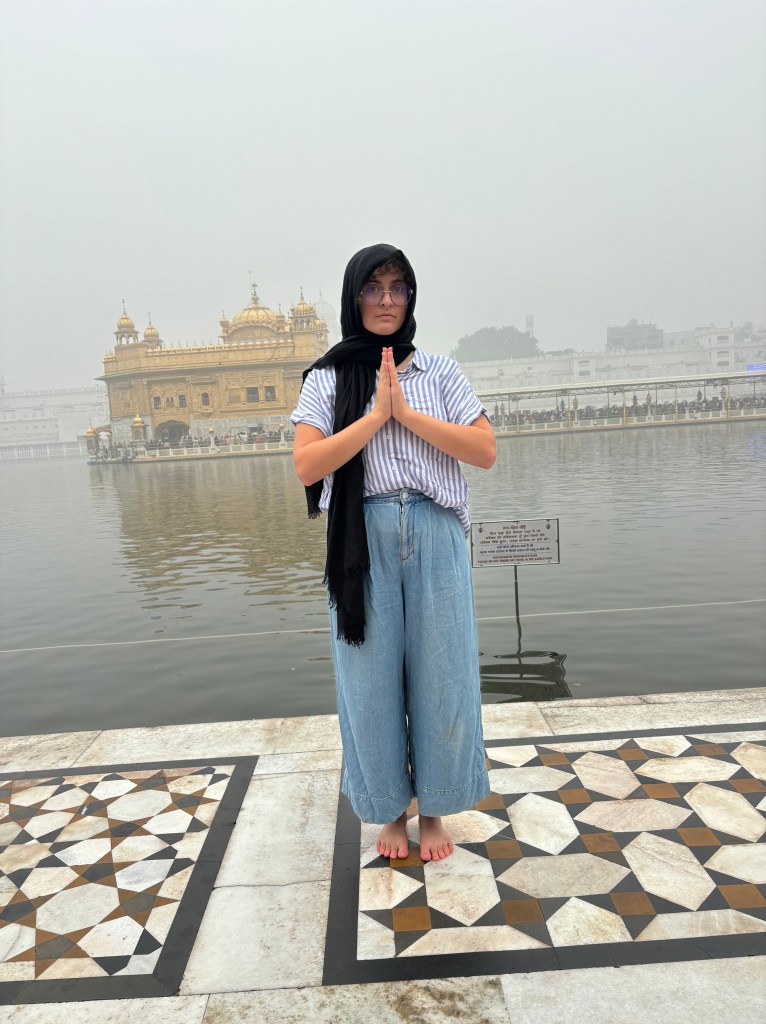
All around the temple, there are guards with spears that discourage people from taking too many pictures. You are not allowed to pose with the temple, which means you cannot position your body in a certain way or smile. In fact, the only thing you can do in a picture with the temple is have your hands in a customary praying position, glorifying God before yourself (this is pictured below).
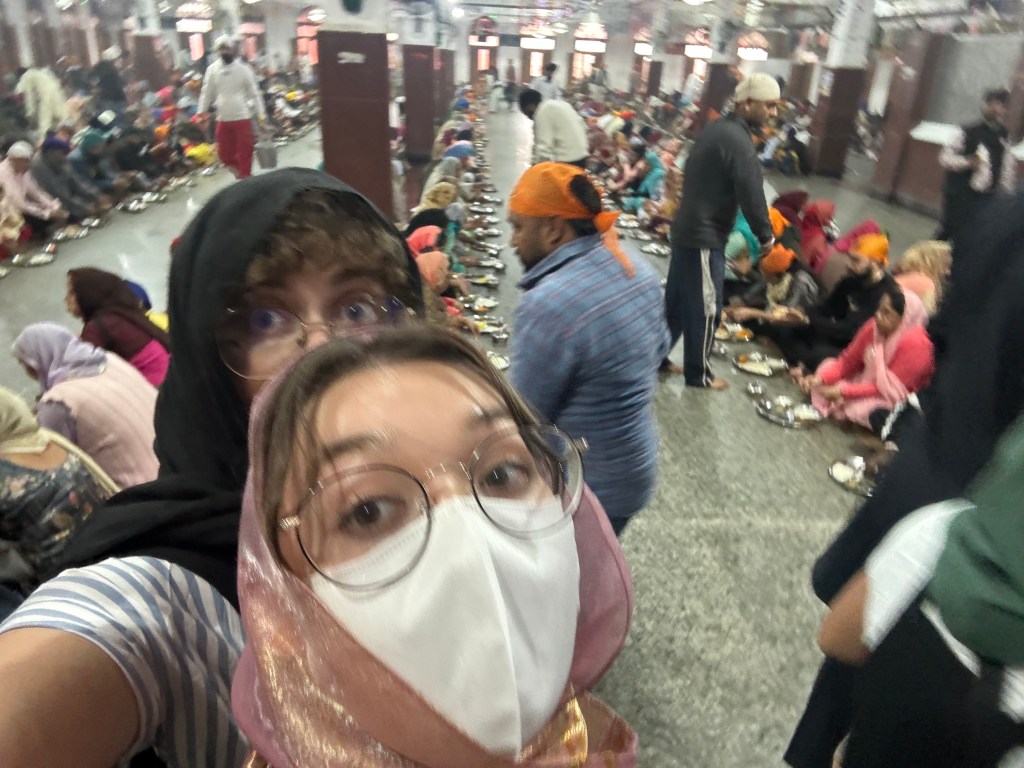
Right by the temple is the world’s largest community kitchen, which you are allowed to take pictures of. Service, or seva, is crucial to practicing Sikhism. Many worshipers will practice seva by volunteering their time in the communal kitchen, cooking the free food offered to any and all who come to Amritsar. Seeing people cooking, cleaning, and eating in this space was truly one of the most touching experiences I’ve ever had. While I was there, I felt nothing but love. To me, an outsider, it seems that everything about the Sikh faith is about loving God and the people around you.
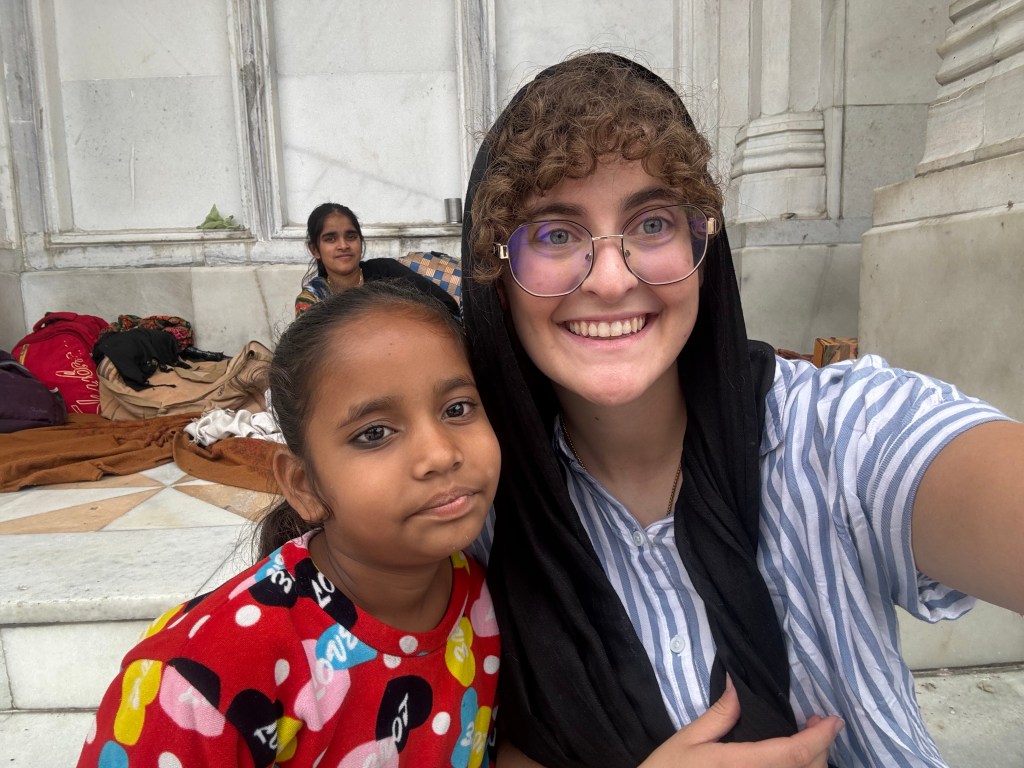
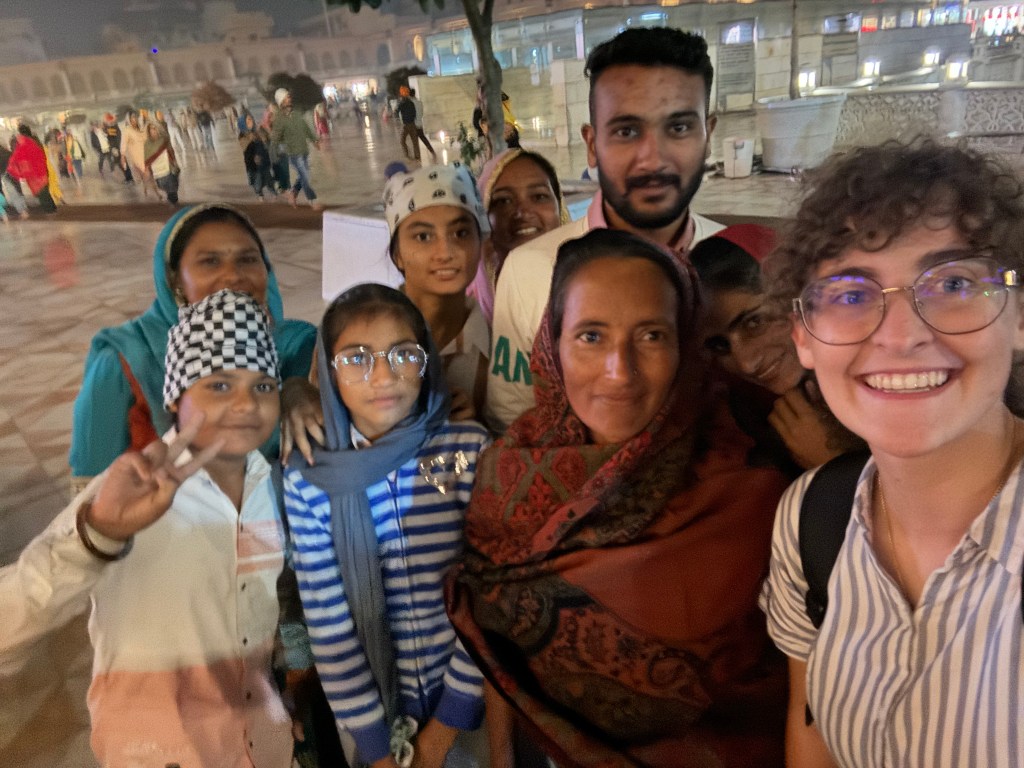
That’s the note I’ll end on: love. I think that India is the most smile-y country I’ve ever been to. People go out of their way to welcome a large group of white tourists to their town. Everyone wants a picture with me here. And whenever I need help, many people are there ready to lend a hand. In my experience at Amritsar, I felt a deep love that I wish I could feel all the time.
How do you show love? How does this affect you spiritually?
Hinduism
Also called Sanatana Dharma. Some consider it to be the world’s oldest religion. Indigenous religion of India and surrounding areas (in fact, “Hindu” truly refers only to a person that lives in this area, rather than someone that follows Sanatana Dharma). Came into being when the Dravidians interacted with the native people in this area. Written canon are the Shruti and the Smriti. Believe in reincarnation, gods, karma, and Nirvana (meaning release from the wheel of reincarnation and rejoining Brahman). No central leadership or required orthodoxy.
“Hinduism Basics.” Hindu American Foundation. (https://www.hinduamerican.org/hinduism-basics)
Jainism
Means “to conquer.” Religion that began in India that is thought to have started around the sixth or fifth century BCE. Founded by Mahavira, a monastic. Don’t believe in a god; believe in ascestics with authority who are referred to as “Jinas” or “Tirthankaras.” Mahavira is thought to have been the twenty-fourth Jina ever. Believe in reincarnation, trying to rid the soul of karma-matter, and release. Venerate scripture (Digambara and Svetambara) because it is believed that they came from the words of Mahavira in one way or another. Heavily focused on ahimsa. Monks will strain water, sweep roads, wear masks, etc. to keep from harming even the smallest life form.
“Jainism.” Minnesota Libraries Publishing Project. (https://mlpp.pressbooks.pub/worldreligionsthespiritsearching/chapter/jainism/)
Sikhism
“The word Sikh (pronounced “sickh”) means ‘disciple’ or ‘learner.’ The Sikh religion was founded in Northern India in the fifteenth century by Guru Nanak and is…monotheistic and stresses the equality of all men and women. Sikhs believe in three basic principles; meditating on the name of God (praying), earning a living by honest means as well as sharing the fruits of one’s labor with others. Sikhism rejects caste and class systems and emphasizes service to humanity.” Baptized members are part of the Khalsa and wear five tokens of commitment: unshorn hair, comb, bracelet, undergarment, and a blade. Worship in gurdwaras. Read and reverence their scripture, the Guru Granth Sahib.
“Who are Sikhs? What is Sikhism?” SikhNet. (https://www.sikhnet.com/pages/who-are-sikhs-what-is-sikhism)
The Golden Temple of Amritsar
“The Golden Temple Amritsar India (Sri Darbar Sahib Amritsar) is not only a central religious place of the Sikhs, but also a symbol of human brotherhood and equality. Everybody, irrespective of caste, creed or race can seek spiritual solace and religious fulfillment without any hindrance. It also represents the distinct identity, glory and heritage of the Sikhs…Built at a level lower than the surrounding land level, the Gurdwara teaches the lesson of egalitarianism and humility. The four entrances of this holy shrine from all four directions, signify that people belonging to every walk of life are equally welcome.” Sikh religious site built on a body of water (Amritsar) that is believed to possess redemptive qualities.
“Sri Darbar Sahib.” Travel Guide to Golden Temple Amritsar. (https://www.goldentempleamritsar.org/famous-temples-in-india/amritsar/golden-temple/)
Axis Mundi
Latin phrase meaning “world axis.” Usually refers to the connection between heaven and earth in religious settings.
“Axis Mundi.” MAP Academy. (mapacademy.io/glossary/axis-mundi/#:~:text=A%20Latin%20phrase%20meaning%20“world,Pre%2DModern%20Art)
Seva
“The highest service according to Sikh religion is [the] service of mankind. Seva in Sikhism means selfless and voluntary service for the benefit of humanity without any personal gain. Seva enjoins a Sikh to promote the welfare of his fellow beings. Seva is an activity that is not recognized as an individual action for self aggrandizement or glory. According to Sikh tradition, service is regarded as part of supreme worship.”
“Seva (Selfless Service).” Sikh Missionary Society U.K. (https://www.sikhmissionarysociety.org/sms/smssikhism/institutions/seva/)

 Hallow
Leave a comment