
When I get older, I will be stronger/ They’ll call me freedom just like a wavin’ flag / And then it goes back, and then it goes back / And then it goes back, oh
K’Naan, “Wavin’ Flag”
I don’t know about you, but when I think of Nepal, I get a pretty clear picture in my mind. In this picture, I’m standing at the foot of the Himalayas, looking at the perfectly visible peak of Mount Everest. There are yaks everywhere, and it’s snowy, yet the sky is stunningly blue. There are yaks wandering freely everywhere I look. Nepalese guides smile at me. And on every available structure, prayer flags are hanging.
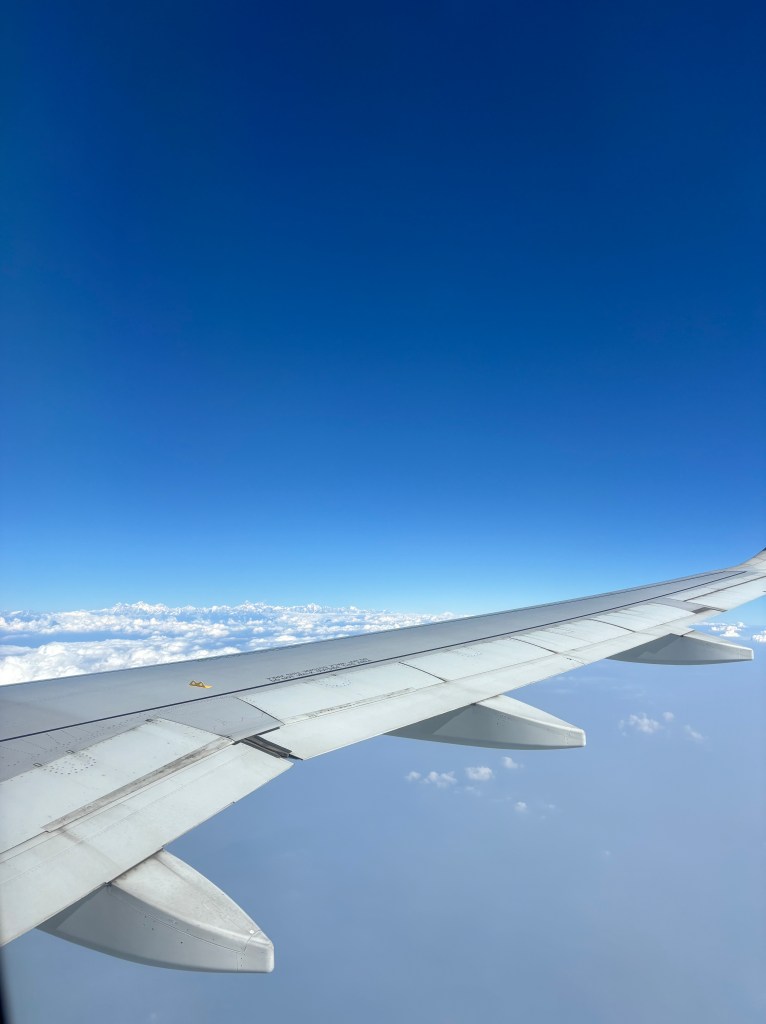
As soon as I flew into Nepal, I realized that my mental image was far from actuality. The Himalayas are so tall that I saw some peaks above the clouds from a plane, but from the capital city of Kathmandu, you can hardly see any mountains at all. This is in part due to the air quality which, though better than India’s, is usually pretty poor. It wasn’t snowy and actually remained a pretty good temperature throughout my visit, despite it being the end of November. The buildings are tall and crowded together, and the streets are bustling with natives and tourists alike. Sadly, no yaks in sight. But, there was one part of my mental image that was accurate: the prayer flags.
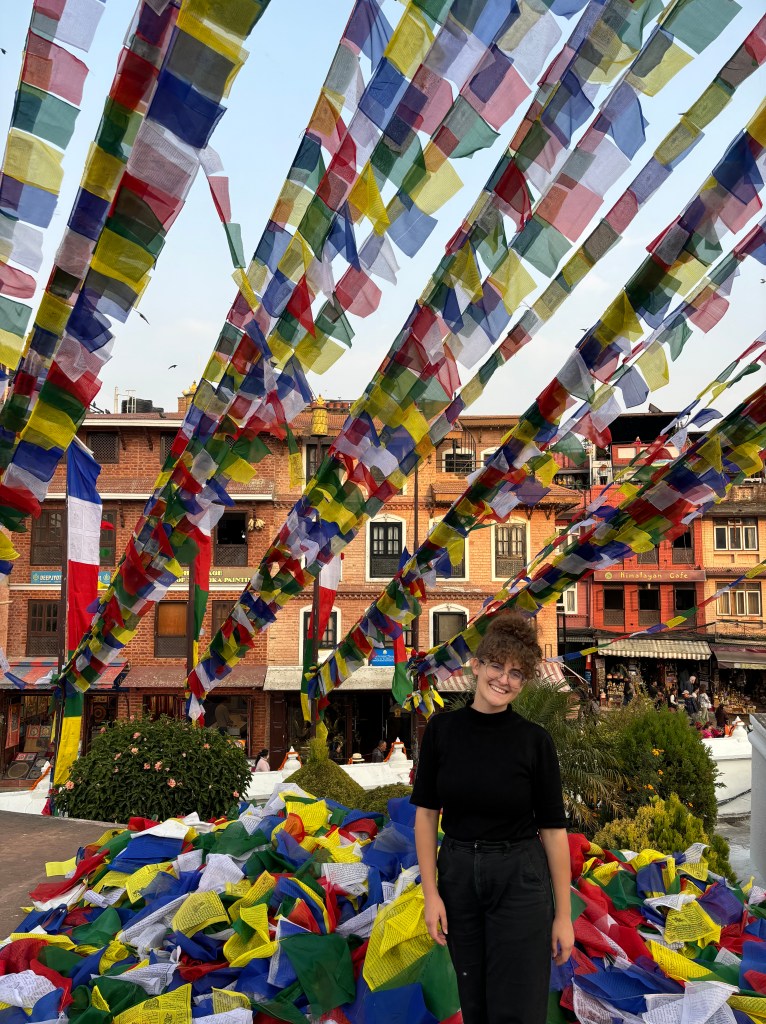
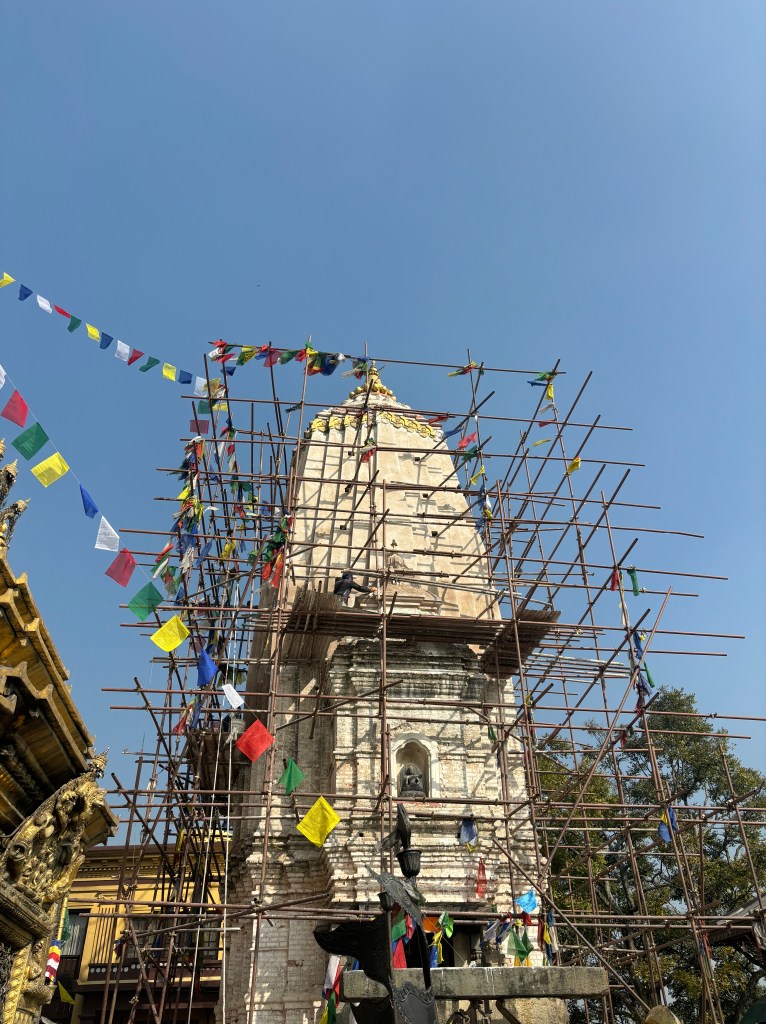
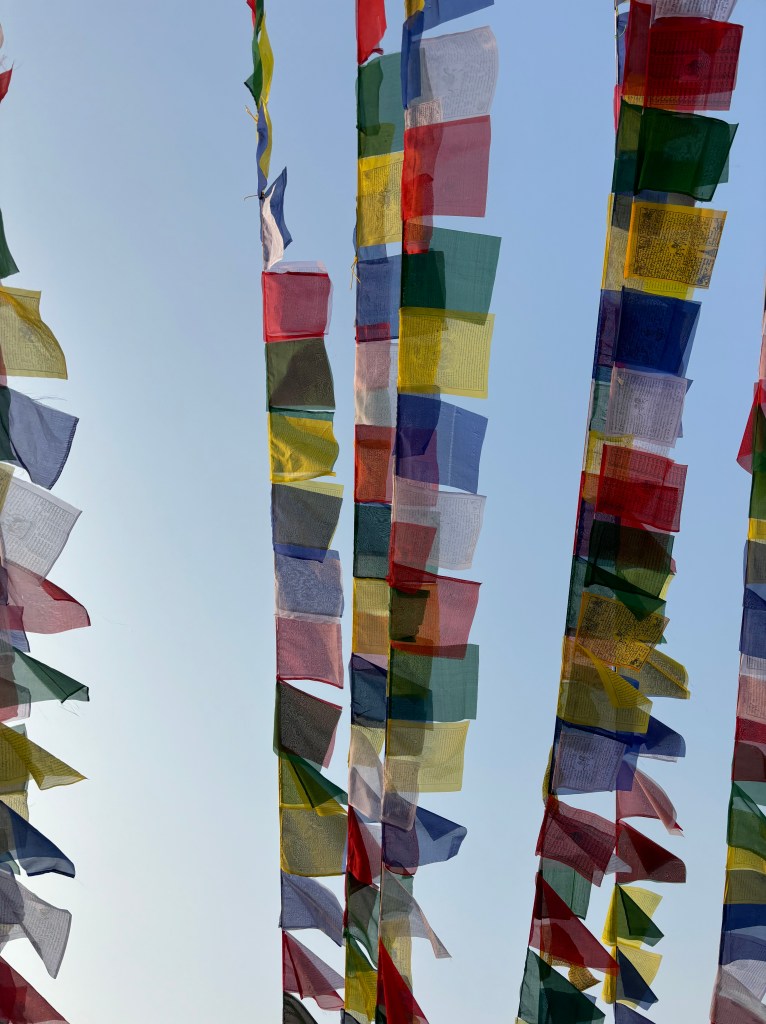
Buddhist prayer flags truly cover Nepal. They are mostly found in temples, but it isn’t unusual to find them in shopping centers or on the handlebars of motorcycles. It’s a recognizable symbol for all tourists. During my time in this amazing country, I learned a little more about the significance of these beautiful flags.
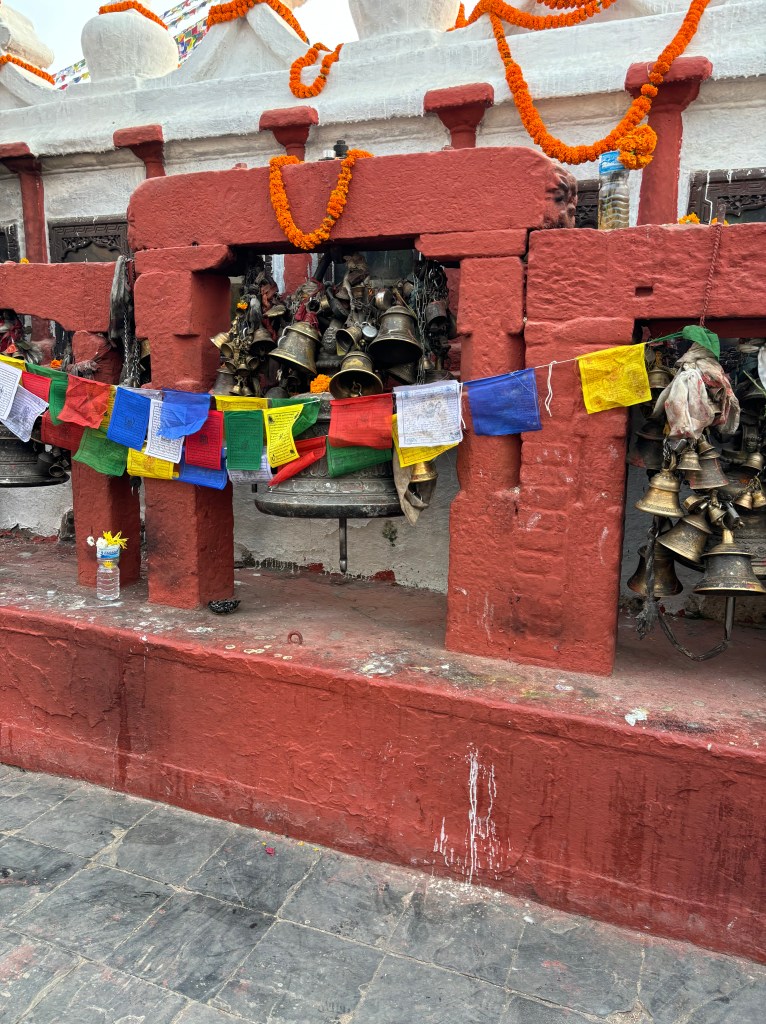
In Buddhism, the colors red, green, yellow, blue and white all hold symbolic significance. (Please note that I learned these meanings in India and Nepal, which practice most aligns with Tibetan Buddhism, so this might not be an entirely universal interpretation of these colors.)
- Red: life force and preservation. The element of fire.
- Yellow: rootedness and renunciation. The element of earth.
- Green: balance and harmony. The element of water.
- Blue: purity and healing. The element of sky.
- White: learning and knowledge. The element of air.
(Shoutout to https://www.tibettravel.org/tibetan-buddhism/meanings-of-colors-in-tibet.html for jogging my memory here.)
In any Buddhist location, anywhere in the world, you will find these five colors grouped together. In flags especially, they mark a space as Buddhist.
In Nepal and Tibet, these prayer flags are especially significant because of their use. Unlike other Buddhist flags, they are adorned with illustrations and words. They usually recall certain mantras. According to what I know about them (which really isn’t much), the air and wind carry the prayers out as they travel through the flags. They are a necessary part of any holy space, whether it be a living area to a large stupa.
Seeing these amazing, faith-inspiring objects, I’ve thought a lot about the symbols of my own faith. What things remind me of my beliefs? When I want to make something holy, what do I need to add or take away?
I’d love to hear your thoughts!
Vajrayana Buddhism (Tibetan Buddhism)
“Vajrayana is a form of Mahayana Buddhism that originated in northern India around the 5th century CE, took root in Tibet in the 7th and 8th centuries, and then spread across the Himalayan region. It is widely known as Tibetan Buddhism…Vajrayana takes its name from vajra, Sanskrit for “diamond” or “thunderbolt,” suggesting the power of its methods. Although Vajrayana shares with the Mahayana schools generally the view that we are already perfected and can awaken in a single lifetime, Vajrayana considers itself the fastest way to enlightenment. Its canon consists of texts known as the Kangyur (sutras and tantras considered to be the words of the Buddha) and the Tengyur (commentaries)…Ritual is key, including repetition of mantras (sacred syllables and verses), visualization of mandalas (sacred diagrams), sacred hand gestures (mudras), and prostrations…[I]ts most notable leader is the Dalai Lama.”
“What is Vajrayana Buddhism?” Tricycle: Buddhism for Beginners. (https://tricycle.org/beginners/buddhism/what-is-vajrayana-buddhism/)
 Hallow
Leave a comment