
Yes, it was my way.
Frank Sinatra, “My Way”
Throughout my travels, I’ve experienced a lot of religious practices that are very different than my own. From simple differences to big disagreements, dealing with different beliefs isn’t always an easy thing to do. I wanted to share my few thoughts about how to deal with this issue, and I wanted to start with an example.
Recently, I flew into Japan, a country filled with Shinto shrines and Buddhist temples. Because of cultural mingling, these two different religions are very closely tied in Japan, occasionally to the point that I can’t tell if I’m at a temple or a shrine. In both places, deities and honored beings are treated as real people. This can be seen in the knitted clothing for statues and not walking through torii gates (reserving that privilege for the gods). In my religious tradition, I’m not used to treating divine beings this way, and I have a hard time understanding these practices.

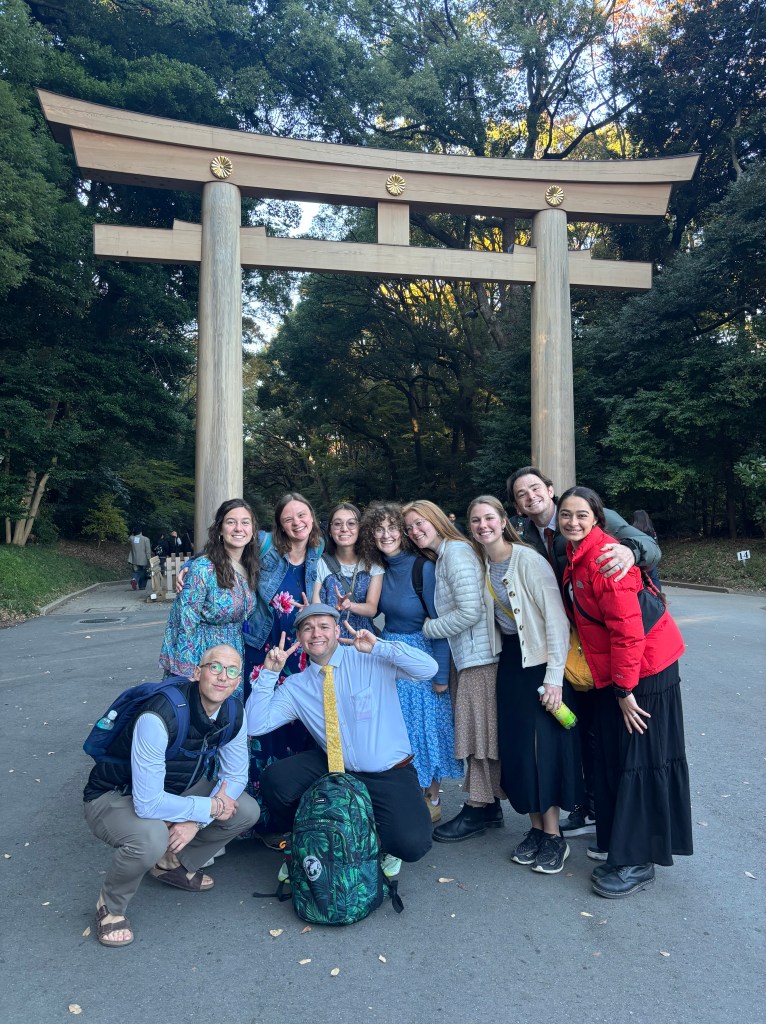
The first step I usually try to take is simply asking myself, “Does this practice hurt me or others?” For most practices, the answer will be “no.” Keep in mind that there’s a difference between being hurt and being uncomfortable: one helps you grow, and one halts all growth. While people use all types of practices to connect spiritually, it’s never permissible to abuse someone else in the name of your own connection with a higher power. Examples of this might include racial segregation, bodily harm, or verbal humiliation. If there is true harm happening because of religious practice, you don’t need to still engage with it in hopes of having a good interfaith experience. It’s okay to go if a practice is harmful.
In this case, do knitted vests and gates I’m not allowed to walk through hurt me? Not at all. Because I’ve answered this question, I’m more able to interact with the belief I’ve come in contact with instead of outright rejecting it.
Next, I think about what beliefs could explain a practice. People usually don’t do things without a reason. Once you understand, even in part, the doctrines and teachings behind a practice, it’s a lot easier to relate to. You might even find newfound loves and desires within yourself.
With torii gates, Shinto practitioners honor the kami to a very high degree, out of both love and fear. I mean, their gods are the forces of nature, so that makes sense. Additionally, they believe that the gods are everywhere, all the time. If I was a Shinto practitioner, I would also want to treat them with the highest degree of respect. One way I could do that is by not defiling their sacred spaces.
If I get to the point of understanding a practice, I usually will take time to think about and enjoy the beauty of said practice. It doesn’t have to be crazy or over-the-top. Whenever you think about the practice again, remember what you’ve learned about it and how it makes you feel.
I personally wouldn’t knit a sweater for a religious statue. But every time I see one now, I have to smile. I think about the loving hands that crafted it and how it must have felt to put it on an object of devotion. I think that’s beautiful!
What religious practices do you find beautiful? Why do you think of them in that way?
Shinto
“Shinto is the indigenous faith of the Japanese. It is a way of life and a way of thinking that has been an integral part of Japanese culture since ancient times. It is the foundation for the yearly life-cycles, beginning with the New Year’s Day visit Japanese pay to a Shinto shrine to wish for good luck. Observing the Shinto faith means worshipping ancestors as guardians of the family. It also means showing respect for the myriad kami—a word that corresponds to ‘deity’ in English—residing in the natural world…Shinto places great value in the virtues of purity and honesty, yet as a faith, Shinto has no dogma, doctrine, or founder. Its origins can be seen in the relationship between the ancient Japanese and the power they found in the natural world. It is a relationship that continues to this day, defined by a great reverence for nature’s strength, and gratitude for nature’s bounty. Only by both receiving the blessings of nature and accepting its rage can we maintain a harmonious connection to the world around us.”
“What is Shinto?” Jinja Honcho: Association of Shinto Shrines. (https://www.jinjahoncho.or.jp/en/shinto/index.html)
Shinto Shrine/Jinja
“A jinja and its grounds are like the home of the kami. You should treat it with the respect you would show when visiting an important person in their home.” Upon entering, you will see torii, a purification font for cleansing hands and mouth, and a pair of animal statues called “Koma Inu.” There are typically many structures at one jinja, and you can pay your respects to specific kami at them. Other rituals take place here. Often, blessings, amulets, fortunes, and votive tablets can be obtained through a donation fee to keep the power of the kami with you when you leave the shrine.
“About Jinja.” Jinja Honcho: Association of Shinto Shrines. (https://www.jinjahoncho.or.jp/en/shrines/index.html)
Buddhist Temple
Place of worship for Buddhist practitioners. All contain some type of representation of the Buddha. Might have a shrine (place where the image of the Buddha is kept) and gardens (used for reflection). Monks and nuns might practice and/or live at the temple. Commonly, shoes will be taken off and people will sit and meditate. Chanting and offerings are other common ways of worship at the temple.
“A Visit to a Buddhist Temple.” BBC Bitesize. (https://www.bbc.co.uk/bitesize/articles/zh9xm39)
Torii
“The entrance to a jinja [Shinto shrine] is marked by a torii. The torii marks the border between the sacred space of the jinja and the everyday world outside, and so many people pause and bow their heads slightly before walking through.”
“Entering a Jinja.” Jinja Honcho: Association of Shinto Shrines. (https://www.jinjahoncho.or.jp/en/shrines/index.html)
Kami
Shinto spirits/gods. Corresponds to “deity” in English. They live in the natural world. “There are kami of the mountains, and kami of the sea. Kami are all around us, in every thing and every person. They may be worshipped anywhere, but many people visit Shinto shrines, called jinja, to pray, cleansing their hands and mouth at the entrance to purify the body and mind.”
“What is Shinto?” Jinja Honcho: Association of Shinto Shrines. (https://www.jinjahoncho.or.jp/en/shinto/index.html)
 Hallow
Leave a comment