
לֹֽא־תִקֹּ֤ם וְלֹֽא־תִטֹּר֙ אֶת־בְּנֵ֣י עַמֶּ֔ךָ וְאָֽהַבְתָּ֥ לְרֵעֲךָ֖ כָּמ֑וֹךָ אֲנִ֖י יְהֹוָֽה׃
(You shall not take vengeance or bear a grudge against members of your people. Love your fellow [Israelite] as yourself: I am יהוה.)
Leviticus 19:18, Sefaria.org

It’s really, really, really easy to tell someone you don’t love that you love them. I mean, I do it all the time, and I can think of many instances in the past when I’ve done it.
Why on earth do I feel the need to lie about something so important?
I think in my case, it’s something that I’m aspiring to. As a Christian (or, more specifically, a member of the Church of Jesus Christ of Latter-day Saints), I believe I have been given the commandment that Jesus Christ Himself that can be found in Mark 12:30-31 in the Christian New Testament. I really want to live up to this huge love. Maybe telling people I love them (even when it isn’t true) is one way that I can start living up to this monumental commandment.
The truth of the matter is, though, that this really is a lie. I know of many stories where someone was hurt by a Christian professing love, yet acting in hate. Indeed, to bring it to an even broader scale, many of the worst acts of hate were committed under the mask of religious love. That’s wrong. Even if I’m trying to love others, being a hypocrite will always turn out badly.
This fact brings up a few interesting thoughts for me.
- Well, what’s better for me to say? Should I now live in this world where I only interact with people I really, really love to keep from hurting anyone’s feelings? That doesn’t seem feasible, nor does it sound good for me.
- Is it just not even possible for me to perfectly love everyone? Does this mean that I should just stop trying?
- And, most importantly, how can I have my action match my speech, and vice versa?
I can honestly tell you that I can’t really answer these questions. But this is a topic that all Christians everywhere must wrestle with if we are to be true disciples of Christ.
Interestingly enough, some of the best insights into this eternal problem were presented to me by a Jewish rabbi. Rabbi Shai Held of the Hadar Institute came to BYU a few weeks ago, and the things he said about religious love have stuck with me in the following days.
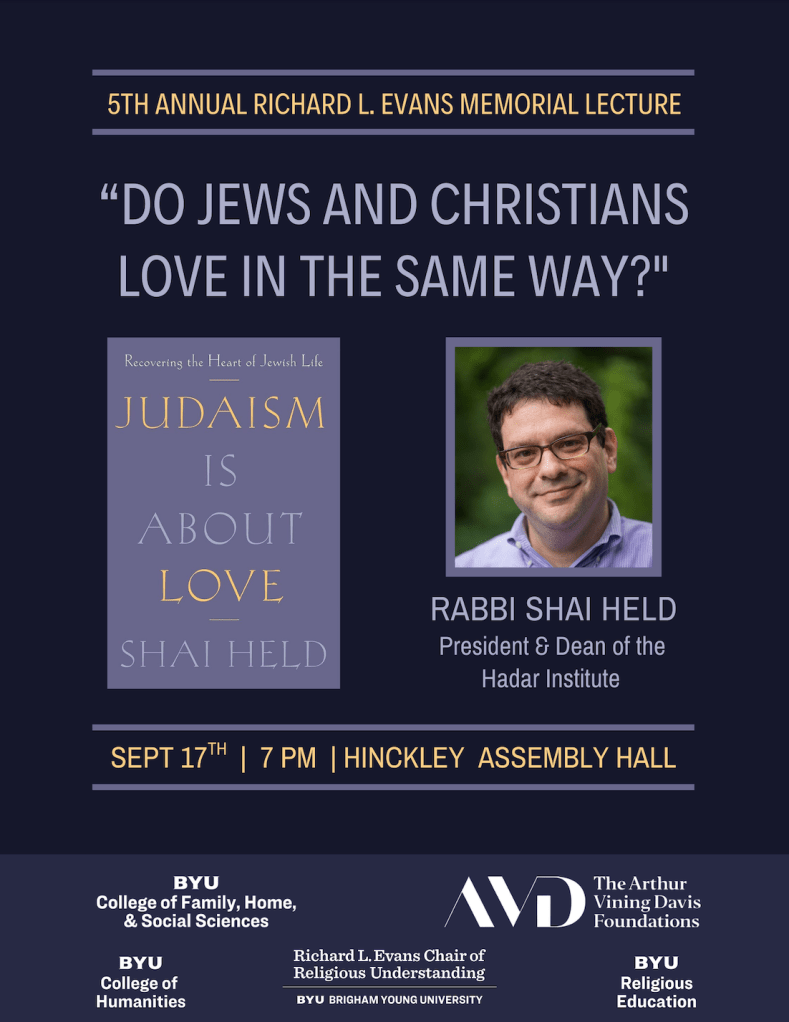
As I’m an Ancient Near Eastern scholar, I’m sure you won’t be surprised to hear that I was enthralled when right off the bat, Rabbi Held dove into the Hebrew Bible.
Rabbi Held reminded the audience that in the book of Genesis, the Lord creates humankind in His image (בְּצַלְמֵ֖נוּ, from the root word צֶלֶם). To my great interest, he taught that this same root word (צֶלֶם) is used to describe the graven images and idols that the Israelites are not supposed to worship (ex. Daniel 3:3).
I know that was a lot of citing, I promise there’s a point to all of this!
So, from the Hebrew Bible itself, we learn that there is only one type of image of the Lord that is okay. And what image is that? It’s the image of people. The Lord Himself made this image, so that shows that it is the only authorized image in His Eye. Any other images made to depict or mimic him are abominable and sinful.
My husband and I have often discussed how the whole “idol worship” thing in the Hebrew Bible is vastly different than our culture today. There are many valuable lessons that we can learn from it though, and this lecture brought up an important new takeaway: the only image that people should revere like God is other people.
These teachings honestly took my breath away. I think something that my “limitless” Christian love has been lacking is the reason for loving others. I was reminded that remembering who people really are is a vital key in loving in a profound way.
In all of this, I couldn’t help but be reminded of a popular C. S. Lewis quote from his sermon, The Weight of Glory: “It is a serious thing to live in a society of possible gods and goddesses, to remember that the dullest most uninteresting person you can talk to may one day be a creature which, if you saw it now, you would be strongly tempted to worship…All day long we are, in some degree helping each other to one or the other of these destinations. It is in the light of these overwhelming possibilities, it is with the awe and the circumspection proper to them, that we should conduct all of our dealings with one another, all friendships, all loves, all play, all politics. There are no ordinary people. You have never talked to a mere mortal. Nations, cultures, arts, civilizations – these are mortal, and their life is to ours as the life of a gnat. But it is immortals whom we joke with, work with, marry, snub, and exploit – immortal horrors or everlasting splendors.”
When I interact with other faiths, I often find myself remembering or being taught values that I really need in my life. This was one of those times.
Some religious scholars I’ve met have expressed anxiety about their faith communities turning away from them. They worry that critical thinking might appear in contrast to true faith. They worry that finding truth in extra-scriptural texts and opinions might diminish finding truth in what is traditionally deemed “appropriate.” They worry that learning and growing alongside all people of all faiths might draw them away from their own.
I’m here to tell you that this is simply not true. I think it’s best put in the words of Rabbi Held: “What is most precious to your religion might not be unique to your religion.”
He’s right.
Precious things are everywhere and are not limited to any one type of people. Stephen Prothero writes about different goals of religions in the book, God Is Not One, and I agree that you can’t funnel every religion into “a path towards the same destination, because they aren’t. Yet the best morals and practices can be found across many faiths because they help all types of people.
In fact, Rabbi Held even said that it is best to remember that there is only one type of person. We can see this in Genesis as well, that while many types of birds, fish, plants, and animals are created, the Lord only creates one type of human.

So, I can proudly say that listening and learning from a Jewish rabbi has deeply changed the way I see Christian love. Going forward, his teachings will change the way I practice my own faith.
It’s a beautiful thing, isn’t it? Images of the Lord, all of us, walking the earth, learning and growing from one another. Hopefully, we will eventually live up to the Lord we are copied from.

Christianity
“Christianity, major religion stemming from the life, teachings, and death of Jesus of Nazareth (the Christ, or the Anointed One of God) in the 1st century CE…It has a constituency of more than two billion believers. Its largest groups are the Roman Catholic Church, the Eastern Orthodox churches, and the Protestant churches…Significant movements within the broader Christian world and sometimes transcending denominational boundaries are Pentecostalism, Charismatic Christianity, Evangelicalism, and fundamentalism. In addition, there are numerous independent churches throughout the world…Christianity is the faith tradition that focuses on the figure of Jesus Christ. In this context, faith refers both to the believers’ act of trust and to the content of their faith…A second element of the faith tradition of Christianity, with rare exceptions, is a plan of salvation or redemption. That is to say, the believers in the church picture themselves as in a plight from which they need rescue. For whatever reason, they have been distanced from God and need to be saved. Christianity is based on a particular experience or scheme directed to the act of saving—that is, of bringing or “buying back,” which is part of what redemption means, these creatures of God to their source in God. The agent of that redemption is Jesus Christ…”
“Christianity: Beliefs, Practices, History.” Encyclopedia Britannica. (https://www.britannica.com/topic/Christianity/Historical-views-of-the-essence)
The Church of Jesus Christ of Latter-day Saints
Culturally called the “Mormon Church,” The Church of Jesus Christ of Latter-day Saints prefers its full title to emphasize its Christian beliefs. Believe that God has called a modern-day prophet to restore the Jesus Christ’s Church, which was corrupted. Teachings include increasing focus on the Savior, caring for the poor, ending personal conflict in lives, and strengthening families.
“Jesus Christ’s Church Is Restored.” The Church of Jesus Christ of Latter-day Saints.(www.churchofjesuschrist.org/welcome/restored-church-of-jesus-christ?lang=eng)
Jesus Christ
Founder and leader of all Christianity. Believed to be the Son of God. Born in Bethlehem around 6-4 BCE. Son of the Virgin Mary. Died around 30 BCE in Jerusalem. The New Testament focuses on Him and His Gospel (meaning His teachings). Teachings focus on honoring God, loving others, the kingdom of God, etc. Performed many miracles. Was captured by the Jews and crucified by the Romans. Believed to have resurrected three days after His death.
“Jesus.” Britannica. (https://www.britannica.com/biography/Jesus/The-relation-of-Jesus-teaching-to-the-Jewish-law)
The New Testament
“The New Testament is the second half of the Christian Bible…The New Testament contains 27 books written in Greek by 15 or 16 different authors between 50 C.E and 120 C.E. It can be divided into 4 groups: Gospels, Acts of the Apostles, Epistles, and Apocalypse. The New Testament contains 4 Gospels: Matthew, Mark, Luke, and John. These books tell the stories about Jesus’ life, ministry, and death…Acts of the Apostles, written by the author of the third Gospel (“Luke”), describes the spread of the Christian church from Jesus’ death to the death of the apostle Paul. Following Acts are 21 epistles or letters. Most of these New Testament books are records of correspondence between a church leader and a Christian community; the New Testament epistles address issues of Christian belief, practice, and ethics…The last book in the New Testament is Revelation, a Christian apocalypse. The author of this book, John, describes the events leading up to the destruction of this world and the appearance of the world to come.”
“Chapter 01 – What Is The New Testament?” Oxford University Press. (https://global.oup.com/us/companion.websites/0195161238/studentresources/chapter01/)
Judaism
“Judaism, monotheistic religion developed among the ancient Hebrews. Judaism is characterized by a belief in one transcendent God who revealed himself to Abraham, Moses, and the Hebrew prophets and by a religious life in accordance with Scriptures and rabbinic traditions. Judaism is the complex phenomenon of a total way of life for the Jewish people, comprising theology, law, and innumerable cultural traditions…In nearly 4,000 years of historical development, the Jewish people and their religion have displayed a remarkable adaptability and continuity…Along universal lines, [Jewish monotheism] has affirmed a God who created and rules the entire world and who at the end of history will redeem all Israel (the classical name for the Jewish people), all humankind, and indeed the whole world. The ultimate goal of all nature and history is an unending reign of cosmic intimacy with God, entailing universal justice and peace. Between creation and redemption lies the particularistic designation of the Jewish people as the locus of God’s activity in the world, as the people chosen by God to be “a kingdom of priests and a holy nation” (Exodus 19:6). This arrangement is designated a covenant and is structured by an elaborate and intricate law. Thus, the Jewish people are both entitled to special privileges and burdened with special responsibilities from God…This people, together with all humanity, is called upon to institute political, economic, and social forms that will affirm divine sovereignty.”
“Judaism: Religion.” Encyclopedia Britannica. (https://www.britannica.com/topic/Judaism)
Rabbi
A teacher; a decider on matters of law. Different branches of Judaism may disagree on who and what a rabbi is (i.e. in matters of gender), but the basic definition remains the same.
“Rabbis, Priests, and Other Religious Functionaries.” Judaism 101. (www.jewfaq.org/rabbi)
Hadar Institute
“The Hadar Institute is a center of Jewish life, learning, and practice that builds vibrant egalitarian communities in North America and Israel. Our vision for Jewish life is rooted in rigorous and nuanced Torah study, gender equality, meaningful Jewish practice, and the values of kindness and compassion. Since our founding in 2006, Hadar has impacted thousands of people through our programs and content, giving Jews of all ages the tools to access traditional texts and live inspired Jewish lives.”
“About Hadar.” The Hadar Institute. (https://www.hadar.org/about)
Brigham Young University
University affiliated with the Church of Jesus Christ of Latter-day Saints. “The mission of Brigham Young University — founded, supported, and guided by The Church of Jesus Christ of Latter-day Saints — is to assist individuals in their quest for perfection and eternal life…A BYU education should be spiritually strengthening, intellectually enlarging, and character building, leading to lifelong learning and service.”
“About.” Brigham Young University. (https://www.byu.edu/about)
Tanakh/Hebrew Bible
The Hebrew Scriptures. The word “Tanakh” functions somewhat like an acronym for what it contains; the Torah (Law), the Nevi’im (Prophets), and the Ketuvim (Writings) together are the Tanakh.
“The Tanakh.” Jewish Virtual Library. (https://www.jewishvirtuallibrary.org/the-tanakh)
Genesis
“The book of Genesis is the first book of the Bible. It is divided into two main parts, with chapters 1-11 telling the story of God and the whole world, and chapters 12-50 focusing in on the story of God, a man, and his family. These two parts are connected by a sort of “hinge” story in the beginning of chapter 12. This literary design gives us a clue as to how to understand the message of the book as a whole, as well as how the entire story of the Bible comes together. The Big Idea: Out of disorder and darkness, God creates order, beauty, and goodness. From Genesis 3 onward, humans continue acting selfishly and doing evil, but God remains faithful and refuses to abandon them or his world.”
“Book of Genesis.” BibleProject. (https://bibleproject.com/guides/book-of-genesis/)
Daniel
A book in the Jewish Tanakh/Hebrew Bible and the Christian Old Testament. “The book of Daniel is apocalyptic literature that includes several strange visions that point to the coming Son of Man, the messianic King who will deliver Israel and the nations. Daniel is also about hope and faith in the midst of exile, as Daniel remains faithful to Yahweh and hopeful for the restoration of Israel.”
“Book of Daniel Summary.” BibleProject. (https://bibleproject.com/videos/daniel/?gad_source=1&gad_campaignid=16256516528&gbraid=0AAAAADNn2r8YlIzD8hacB0cF7CYtMGGkZ&gclid=CjwKCAjw89jGBhB0EiwA2o1On_BIbBTsrtTEHZFiPPKyWpIdtQ-h52BMx6k3Y1gcMPqfws8mZ3sUuxoC4MMQAvD_BwE)
C. S. Lewis
“Clive Staples Lewis was one of the most influential writers of the 20th Century. A brilliant and imaginative thinker, Lewis was a scholar and professor of English literature with positions at Oxford and Cambridge. Yet he became best known for his popular works of children’s fantasy and his writings and talks on the Christian faith…Once an avowed atheist, Lewis’s own intellectual and spiritual journey led him to the God of the Bible and ultimately to Christ. While he seldom spoke of his beliefs during university lectures, his Christian faith profoundly influenced his writing. C.S. Lewis wrote over thirty books, including the Chronicles of Narnia, The Space Trilogy, Mere Christianity, Miracles, Surprised by Joy, The Screwtape Letters, and The Problem of Pain.”
“Meet C. S. Lewis.” C. S. Lewis Institute. (https://www.cslewisinstitute.org/c-s-lewis-life-works/?gad_source=1&gad_campaignid=1053728300&gbraid=0AAAAADDeuTeQTva4nlXxIQT0PU18U7G98&gclid=CjwKCAjw89jGBhB0EiwA2o1On_aH3olrJyYiMc_N559iWRkbBbcJnIr9qa3P6CJTn4sPnRmx5RFl4RoCSyAQAvD_BwE)
 Hallow
Leave a comment