
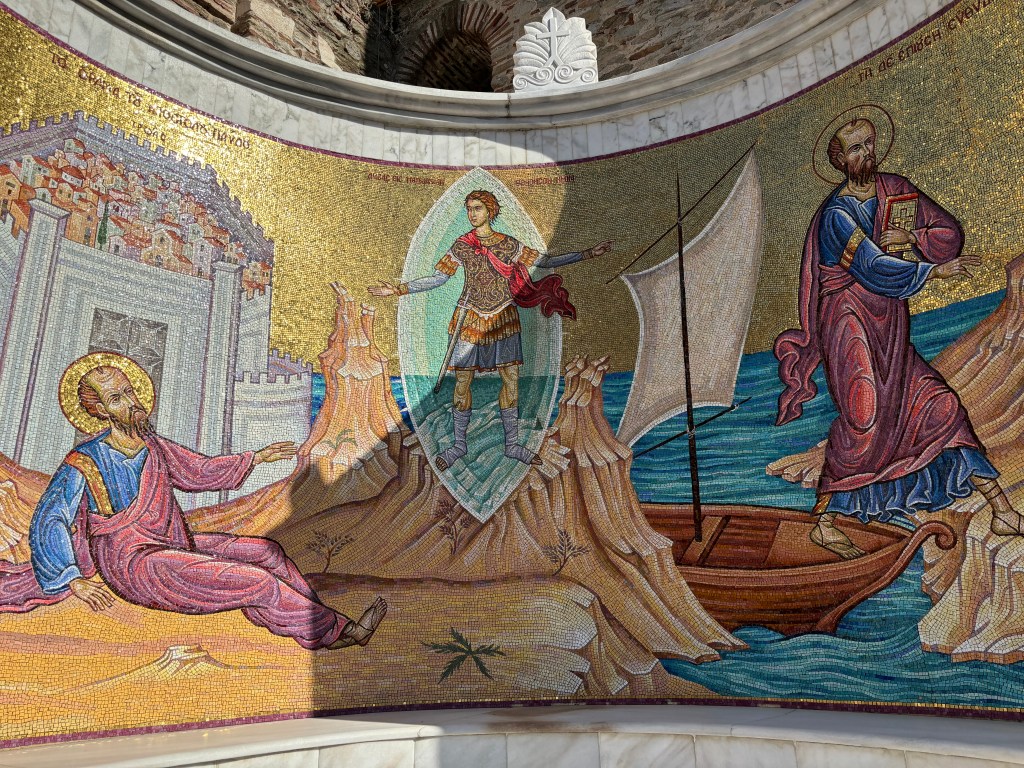
And a vision appeared to Paul in the night; There stood a man of Macedonia, and prayed him, saying, Come over into Macedonia, and help us. And after he had seen the vision, immediately we endeavoured to go into Macedonia, assuredly gathering that the Lord had called us for to preach the gospel unto them.
Acts 16:9-10, KJV
It’s a natural desire to share what you love with people around you. Like when I was six years old and learned how to introduce myself in Spanish, I couldn’t stop myself from saying, “Hola! Me llamo Jessica,” to everyone I came in contact with. For the same reason, you have probably been caught in conversations that center around Funko Pop! collections, television show plot synopses, “hot takes” on books that are hundreds of years old, and the list keeps going. Not always, but sometimes, you can really tell how people feel about something based on how often they talk about it.
I had an interesting chat with a few of my friends today, centering on a single question: “If you believe that a certain church is true, do you think everyone else should also be in that church?” Complicated question, I know. We definitely didn’t find an answer in the hour or so that we were together. Since then, I’ve been considering the many religious takes on proselytizing and helping other people believe the same as you do.
Is it more faithful to proselytize or not? As usual, I have no definitive answer. But it does remind me of my recent visit to Kavala and the archeological site of Philippi. This location has huge significance in Christianity, as the Apostle Paul began his missionary efforts in Europe there. For him and other followers of Jesus Christ, bringing others to the faith was a commandment. By doing this, Paul shaped not only his spiritual life, but the spiritual lives of generations to come.

For some religions, obtaining new converts isn’t a goal at all. Religions like Zoroastrianism are spread through ethnicity and heritage, focusing on strengthening those born into the faith rather than attracting more people to join. Hinduism believes that through the Wheel of Samsara, all will eventually be born Hindu, so there is little point in trying to proselytize. Many religions have many reasons why expanding the faith to nonbelievers is a non-issue.
On the other hand, many religions consider missionary efforts a core tenet of their faith. You may be familiar with proselytizing sects of Christianity such as the Jehovah’s Witnesses, who strive to spread truth to their own communities. Islam also focuses heavily on conversion, bringing more and more converts to the faith over hundreds of years.
Additionally, I have been thinking a lot about this in connection with a book I read over the summer. It’s called God Is Not One by Stephen Prothero. The main point that Prothero made in this book is that religions are so different because they have different goals they seek (i.e. Christianity seeks salvation from sin, while Judaism seeks return from exile). In connection with my thoughts today, I’m reminded that different religions choose their stance on proselytizing based on what their goal is. I hope to write more about this idea in the future.

So, I’m not sure if proselytizing is good or bad. In all likelihood, assigning a moral value isn’t possible except in specific examples.

There is something I’m sure about, though. Whether or not you do it with the intent of converting others, I think it is important to talk about what you believe. It has a powerful effect upon you and the community. It is what you have chosen to devote your life to and I hope that you love it enough to discuss it often. Maybe even more often than your Funko Pop! figurine collection.
What do you love about your belief system?
KJV
The King James Version of the Christian Bible. Translation project funded and finished by King James VI of Scotland. Finished and published in 1611.
“The Story Behind the King James Bible.” The KJV Store. (https://www.thekjvstore.com/articles/the-story-behind-the-king-james-bible/)
Proselytize
“To induce/recruit someone to convert to one’s faith.”
“Proselytize.” Merriam-Webster Dictionary. (https://www.merriam-webster.com/dictionary/proselytize)
Saint Paul the Apostle
“St. Paul, was probably born ten years later than Jesus. The place of his birth was Tarsus, a cosmopolitan city in southern Turkey. He was a Jew and a ‘Roman Citizen’, meaning that he spoke ‘Koine’ Greek, the household language of all educated citizens throughout the Roman empire. Well-educated, he was sent in his late teens to Jerusalem to be instructed in Judaism under the guidance of the eminent Rabbi Gamaliel. Paul, then known as Saul, became a respected Pharisee and understood the danger of the new movement arising from Jesus. He gave himself to eliminating it. While journeying to Damascus, he had an overwhelming experience which rendered him a powerful advocate of Christianity. He took the faith from out of its Jewish confines and planted it within the non-Jewish world. Travelling extensively, he came to Greece, planting churches in Philippi, Thessalonica, Athens, Loutro Elenis and Corinth and is known to have visited Veroia and Crete…Paul kept in contact with the churches he planted by writing letters, some of which are in the New Testament…They are ‘applied Christianity’ rather than ‘systematic theology’.”
“Paul the Apostle.” St. Paul’s Anglican Church Athens. (https://anglicanchurchathens.gr/history-team-st-pauls/paul-the-apostle/)
Jesus Christ
Founder and leader of all Christianity. Believed to be the Son of God. Born in Bethlehem around 6-4 BCE. Son of the Virgin Mary. Died around 30 BCE in Jerusalem. The New Testament focuses on Him and His Gospel (meaning His teachings). Teachings focus on honoring God, loving others, the kingdom of God, etc. Performed many miracles. Was captured by the Jews and crucified by the Romans. Believed to have resurrected three days after His death.
“Jesus.” Britannica. (https://www.britannica.com/biography/Jesus/The-relation-of-Jesus-teaching-to-the-Jewish-law)
Zoroastrianism
Occasionally called “Parsis,” meaning Persian/Iranian. Originated in the Iran area, likely before the 6th century BCE. Founded by Zarathustra (also called Zoroaster), a prophet who received a vision of Ahura Mazda (“Lord of Wisdom”). Proselytizing efforts went slowly at first, but became the world’s largest religion at one time. Emphasis on having good thoughts, saying good words, and doing good deeds; also called the Good Religion. Scripture is called the Avesta. Believe in Ahura Mazda and other divine emanations, the sanctity of three elements (water, fire, earth), saviors, etc.
“Zoroastrianism.” Britannica. (https://www.britannica.com/topic/Zoroastrianism)
Hinduism
Also called Sanatana Dharma. Some consider it to be the world’s oldest religion. Indigenous religion of India and surrounding areas (in fact, “Hindu” truly refers only to a person that lives in this area, rather than someone that follows Sanatana Dharma). Came into being when the Dravidians interacted with the native people in this area. Written canon are the Shruti and the Smriti. Believe in reincarnation, gods, karma, and Nirvana (meaning release from the wheel of reincarnation and rejoining Brahman). No central leadership or required orthodoxy.
“Hinduism Basics.” Hindu American Foundation. (https://www.hinduamerican.org/hinduism-basics)
Wheel of Samsara
Belief shared between Hinduism, Buddhism, and Jainism. Visual representation of the circle of suffering that all life goes through. The wheel of reincarnation. The goal of existence is to leave the illusion of reality and rejoin the divine, breaking the wheel of reincarnation. If more karma is accrued in one life, one will have a worse existence in the next incarnation. If karma is remitted, the next existence will improve.
“Wheel of Life (Bhavacakra).” Lion’s Roar. (https://www.lionsroar.com/buddhism/wheel-of-life-bhavacakra/#:~:text=The%20Wheel%20of%20Life%20is,cycle%20of%20existence%20or%20samsara.)
Jehovah’s Witnesses
“We come from hundreds of ethnic and language backgrounds, yet we are united by common goals. Above all, we want to honor Jehovah, the God of the Bible and the Creator of all things. We do our best to imitate Jesus Christ and are proud to be called Christians. Each of us regularly spends time helping people learn about the Bible and God’s Kingdom. Because we witness, or talk, about Jehovah God and his Kingdom, we are known as Jehovah’s Witnesses.” Believe in one God, Jehovah, and that Jesus Christ was God’s son (but not in a trinitarian sense). Also believe in the Bible, salvation of a relatively small number of people (144,000), loving others, political neutrality, etc.
Jehovah’s Witnesses. (https://www.jw.org/en/)

 Hallow
Leave a reply to marilyn4976 Cancel reply