
“Ohi.”
Ioannis Metaxas
October 28 is a special day for the Grecian world. This holiday is called Ohi Day (spelled Oxi in Greek), which is the Greek word for “no.” It’s the anniversary of the day the Greek prime minister, Ioannis Metaxas, said “no” to Benito Mussolini’s troops entering Greece during the Second World War. Today, Greeks worldwide celebrate bravery and integrity during this amazing holiday.
I was in Athens for Ohi Day, and I celebrated by buying a little flag and watching the school children parade down a main street in town. I was in awe to realize that just one small “no” is still inspiring the hearts of a nation.
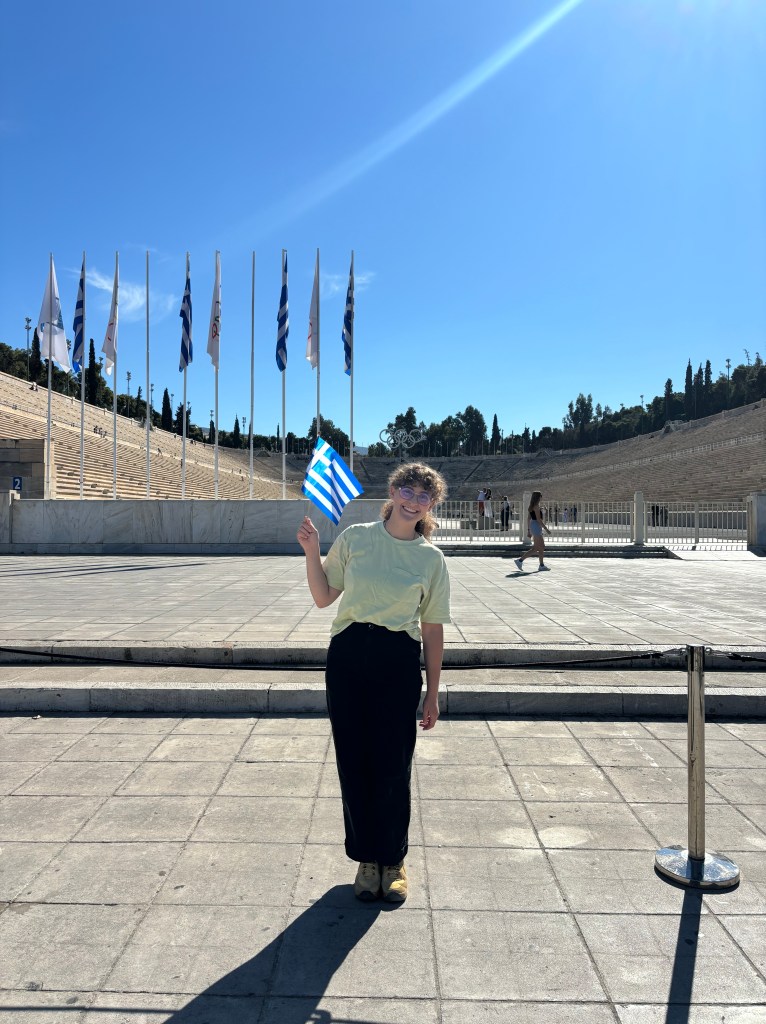
Because of my experience, I was considering the importance of saying no sometimes. In the case of Ohi Day, the “no” was clear and firm, standing up to one of the most terrifying causes that the world has ever seen. Because of this hard “no,” the Greeks fought against the Nazis in a joint effort that would eventually liberate many marginalized religious, ethnic, and other groups from the firm clutches of Adolf Hitler. Sometimes, as in this case, a powerful “no” gets the job done.
The day before, however, I spent a nice meeting with my group on Mars Hill. Just outside the Acropolis of Athens, this is the place where Paul taught people about Christianity, specifically about our relationship to God and the resurrection of Jesus Christ. These people had very different theological takes than Paul, and he very well could have told them “no” in a much harsher way. Instead, he found connections between their beliefs and didn’t force his message upon everyone. Because of this softer “no,” generations of Christians have been able to deepen their faith in God.

So, when should hard and soft “no’s” be used? Especially in a religious context, this is very difficult to answer. From my observations, I only present one thought: it’s important to listen before you say “no.” Both Paul and Ioannis Metaxas took the time to understand their situations, listening to others and paying attention to events that were occurring. After listening, they decided their course of action in an informed way. Because they said “no” wisely, both these men have impacted Greece and the world for generations to come.

Have you ever had to say “no” in an important spiritual situation? Why or why not?
Saint Paul the Apostle
“St. Paul, was probably born ten years later than Jesus. The place of his birth was Tarsus, a cosmopolitan city in southern Turkey. He was a Jew and a ‘Roman Citizen’, meaning that he spoke ‘Koine’ Greek, the household language of all educated citizens throughout the Roman empire. Well-educated, he was sent in his late teens to Jerusalem to be instructed in Judaism under the guidance of the eminent Rabbi Gamaliel. Paul, then known as Saul, became a respected Pharisee and understood the danger of the new movement arising from Jesus. He gave himself to eliminating it. While journeying to Damascus, he had an overwhelming experience which rendered him a powerful advocate of Christianity. He took the faith from out of its Jewish confines and planted it within the non-Jewish world. Travelling extensively, he came to Greece, planting churches in Philippi, Thessalonica, Athens, Loutro Elenis and Corinth and is known to have visited Veroia and Crete…Paul kept in contact with the churches he planted by writing letters, some of which are in the New Testament…They are ‘applied Christianity’ rather than ‘systematic theology’.”
“Paul the Apostle.” St. Paul’s Anglican Church Athens. (https://anglicanchurchathens.gr/history-team-st-pauls/paul-the-apostle/)
Jesus Christ
Founder and leader of all Christianity. Believed to be the Son of God. Born in Bethlehem around 6-4 BCE. Son of the Virgin Mary. Died around 30 BCE in Jerusalem. The New Testament focuses on Him and His Gospel (meaning His teachings). Teachings focus on honoring God, loving others, the kingdom of God, etc. Performed many miracles. Was captured by the Jews and crucified by the Romans. Believed to have resurrected three days after His death.
“Jesus.” Britannica. (https://www.britannica.com/biography/Jesus/The-relation-of-Jesus-teaching-to-the-Jewish-law)

 Hallow
Leave a reply to Marty Halverson-Evans Cancel reply