
All creatures of our God and King / Lift up your voice and with us sing
St. Francis of Assisi, All Creatures of Our God and King
India is a place saturated in so many religions, the most prominent being Hinduism. You can see it everywhere you go: in the clothing, the dress, the music, the interior design, and more. One way that I’ve been able to see Hinduism throughout India is the presence of animals.
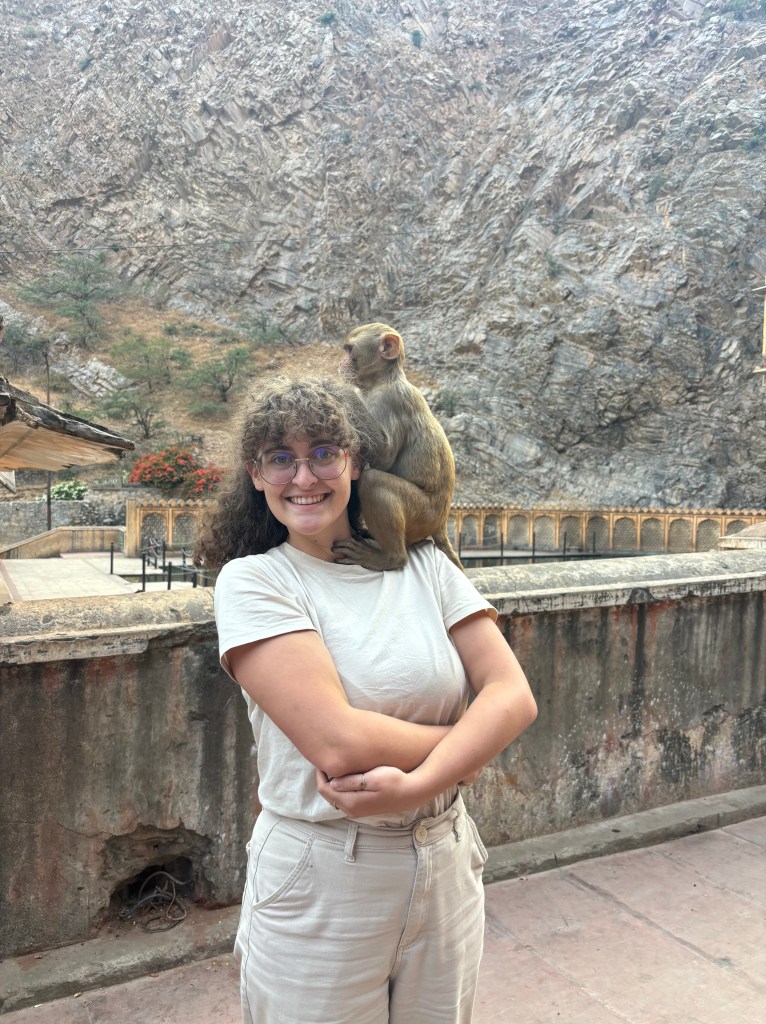
As with many countries, animals freely wander India. But, the strays here are cows and monkeys, rather than just dogs and cats. They’re a little out of control too; I’ve watched the monkeys run away with stolen articles of clothing and the cows eat empty plastic bags. But, there is a reason that these animals are so visible throughout the country.
From what I’ve observed, Hinduism greatly reverences the natural world. In most everything around them, they see both qualities they would like to emulate and others they’d like to be rid of.
One great example of this can be seen in the elephant. Elephants are associated with royalty and power, as they were historically used as vehicles and weapons in both processions and wartime. Despite their intimidating size, however, they are wise, gentle and loyal creatures. Many temples throughout India use the elephant as part of their imagery. Additionally, the god of crossroads and good luck, Ganesha, has the head of an elephant. Though I really don’t know much about the development of Hindu gods, I think there is really something to having a god that so clearly depicts animal characteristics. Ganesha is an elephant, so it’s clear that he’s from India, helping Indians relate to it. He is gentle, wise, and incredibly powerful, all traits that are communicated from a single image rather than a long book of scripture.

Indians are mostly vegetarians, but it isn’t a hard and fast rule. But, no one eats beef. At all. At the McDonald’s and Burger King franchises around the country, you’ll only find chicken and paneer burgers, no hamburgers. This is because the cow is such a sacred animal. From what I understand, it’s seen as a living temple, where milk and services are freely given to those who treat the cow well. So, eating them is a cultural no-no.

I visited a monkey temple on the way to Jaipur, where monkeys pretty much run amok. It’s very fitting that the god worshiped at this site is Hanuman, who has the face of a monkey. Being surrounded by the creatures themselves taught me a lot about what this god’s nature could be. From my experience, I assume that Hanuman must be agile, clever, and protective of those he loves.

From these examples, it’s easy to see that the natural world informs Hinduism just as much as Hinduism tries to explain the natural world. Many religions focus on treating all living things with love, and I’ve enjoyed seeing the way Hindus interpret that.
How do you show your love to the natural world?
Saint Francis of Assisi
1182-1226. Patron Saint of animals, Italy, ecology, etc. Founder of the Franciscan Order and the Poor Clares. Called to repair the Lord’s church. Performed many miracles; received the stigmatae of Christ.
“St. Francis of Assisi.” Vatican News. (https://www.vaticannews.va/en/saints/10/04/st–francis-of-assisi–founder-of-the-franciscan–order–patron-.html)
Hinduism
Also called Sanatana Dharma. Some consider it to be the world’s oldest religion. Indigenous religion of India and surrounding areas (in fact, “Hindu” truly refers only to a person that lives in this area, rather than someone that follows Sanatana Dharma). Came into being when the Dravidians interacted with the native people in this area. Written canon are the Shruti and the Smriti. Believe in reincarnation, gods, karma, and Nirvana (meaning release from the wheel of reincarnation and rejoining Brahman). No central leadership or required orthodoxy.
“Hinduism Basics.” Hindu American Foundation. (https://www.hinduamerican.org/hinduism-basics)
Ganesh/Ganesha
One of the most popular deities in Hinduism. Elephant-headed. Wise and chubby. Known as the “remover of obstacles.” Depicted at the entrance of every Hindu temple. Son of Shiva and Parvati.
“Ganesha Hindu God – The Remover of Obstacles.” Lotus Sculpture. (https://www.lotussculpture.com/ganesha-hindu-god-ganapati-elephant-meaning-symbolism.html?srsltid=AfmBOorBFHoZzK0Ij6lkLl46S4G9g415VPmx7cGQT0mPiad8LBM-d1UY)
Hanuman
Hindu god. Half man, half monkey. Devoted follower of Prince Rama in the Ramayana. Blessed with powers, such as strength and invincibility to fire.
“The Story of Hanuman.” Durham University. (https://www.durham.ac.uk/things-to-do/media/things-to-do/learn/online-resources/secondary-school-resources/The-Story-of-Hanuman.pdf)


 Hallow
Leave a reply to Jessica Robinson Cancel reply