
Is there really a brotherhood of man? / A benevolent brotherhood of man?
Wally Womper, How to Succeed in Business Without Really Trying
My time traveling the world has officially and unfortunately reached its close. In this post, I wanted to reflect on the last city I got to spend time in before I returned to the United States. That city was Hiroshima, Japan.
Hiroshima is a city that will forever live in infamy, but of no fault of its own. At the end of the Second World War, the United States dropped an atomic bomb on this city, assuring Japan’s surrender and ending the war for all involved. However, those who died in the bombing weren’t mobilized troops involved in the conflict. Rather, they were the men, women and children upholding the community from their homes.
Being in Hiroshima isn’t easy. Though the city has been beautifully rebuilt and life thrives throughout its streets, I couldn’t stop thinking of the nuclear atrocity that occurred there less than one hundred years ago. I’m no politician or historian or really anyone that knows anything, but a tragedy like that can’t be excused or forgotten easily. The world still knows and feels the suffering of the atomic bomb.
Locations of great importance are always marked and remembered for generations to come. You might be familiar with places like Gettysburg, Geneva, Normandy, Jerusalem, Pearl Harbor, or Istanbul (to name a few) because of their focus on history. Hiroshima is no different: the city uses a memorial park filled with sculptures and installations to teach about the bombing and inspire future peace. The most meaningful to me was actually built before the bomb was dropped. Just across the river, a pre-explosion domed building still stands.
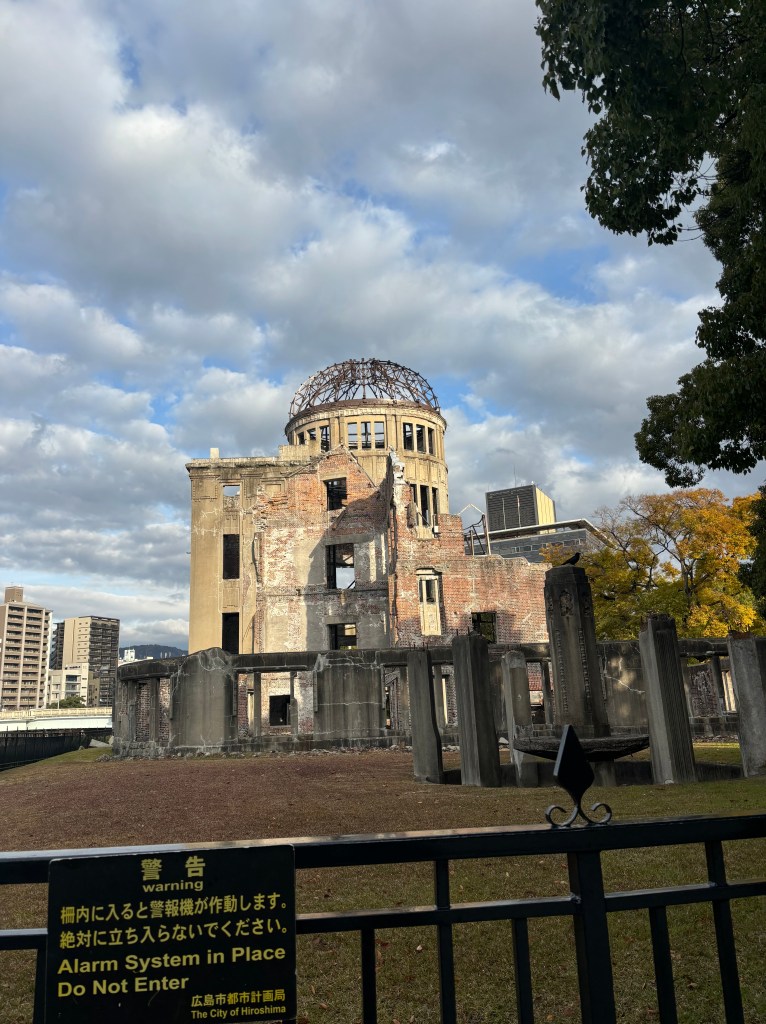
For me, this building testified of the horrors of war. This is what can happen if we stop caring about peace. At the same time, this monument now stands as a beacon of hope: like Hiroshima survived the bombing, the world can survive hard times and still continue on. It spoke volumes that every installation at the park was dedicated to peace throughout the world, rather than just certain peoples or places. The Peace Dome signals all to lay down their weapons and strive for a better future.
On the nearby island of Miyajima, another pre-war structure speaks to the importance of bringing all people in. A Shinto shrine can be found on this island, overlooking the water. In fact, when the tide is high, the water comes underneath the shrine itself, as if the building is floating. The most noticeable part of this structure is its iconic torii gate, which is seen both on the beach and in the water depending on the tide.
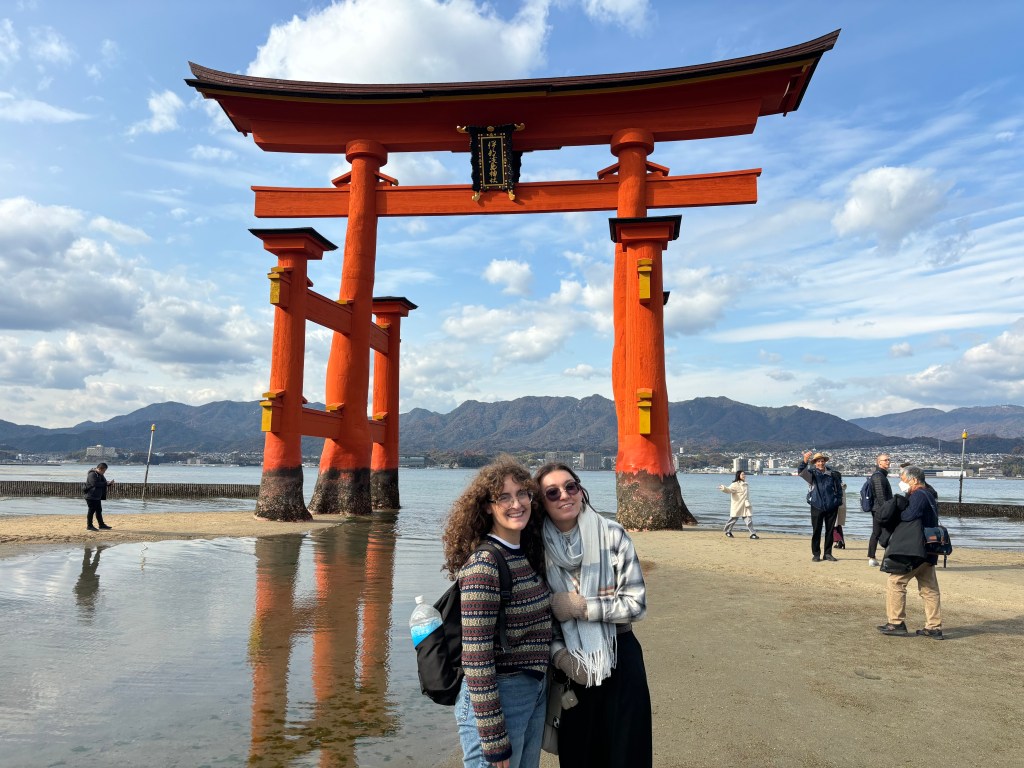
Torii gates welcome gods, spirits, and kami into the shrine. As a big tourist location today, however, I saw this open gate as a welcome to me. I was wanted here.
In the past, I’ve written about separation and how walls are necessary for religion to survive. I want to note now that while differences are vital, welcomeness is another beautiful aspect of faith. In my experience, I’ve come across very few people that aren’t happy to tell me about their faith, particularly when I ask in a kind, interested way. People are open. Religions are open. Though not every religion seeks converts, most do hope for understanding and respect.
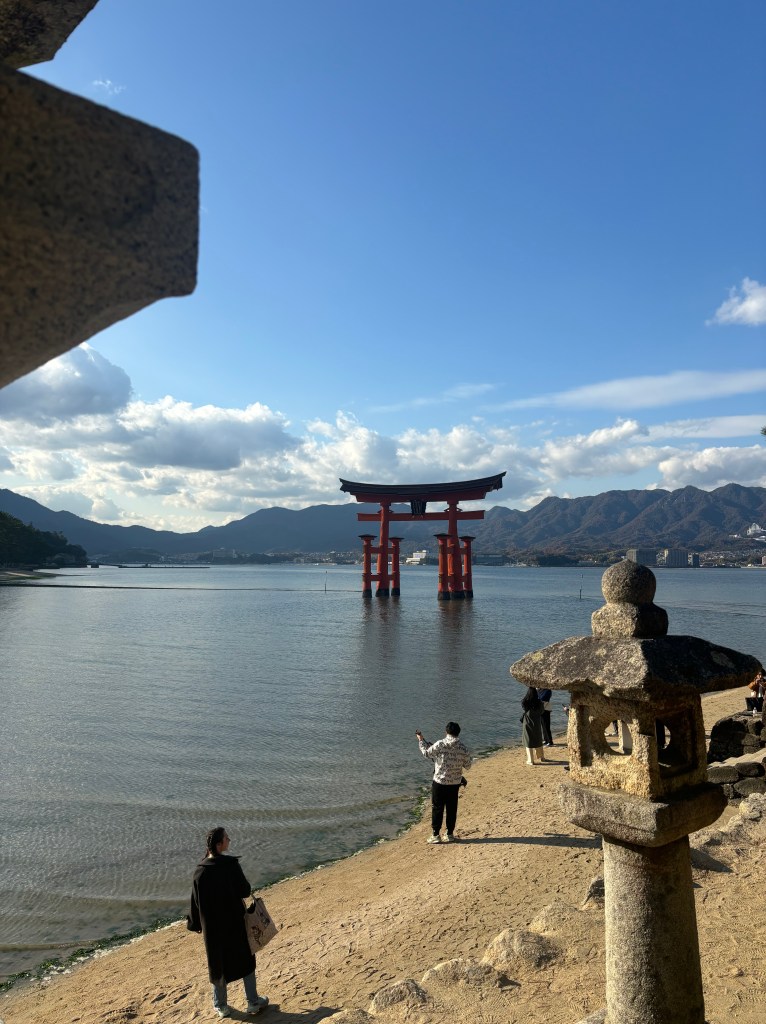
As I saw this gate, I felt welcomed to the Shinto religion. To be clear, I felt no desire to convert, and I’m sure the Shinto practitioners at the shrine that day wouldn’t want me to either. But I belonged, as a neighbor and friend, in their midst. As far as human communities go, I feel that religious congregations have the greatest potential for acceptance of others. That is hardly ever the case, obviously. But these communities are intended to be more open than other types.
How can you be more open?
Shinto
“Shinto is the indigenous faith of the Japanese. It is a way of life and a way of thinking that has been an integral part of Japanese culture since ancient times. It is the foundation for the yearly life-cycles, beginning with the New Year’s Day visit Japanese pay to a Shinto shrine to wish for good luck. Observing the Shinto faith means worshipping ancestors as guardians of the family. It also means showing respect for the myriad kami—a word that corresponds to ‘deity’ in English—residing in the natural world…Shinto places great value in the virtues of purity and honesty, yet as a faith, Shinto has no dogma, doctrine, or founder. Its origins can be seen in the relationship between the ancient Japanese and the power they found in the natural world. It is a relationship that continues to this day, defined by a great reverence for nature’s strength, and gratitude for nature’s bounty. Only by both receiving the blessings of nature and accepting its rage can we maintain a harmonious connection to the world around us.”
“What is Shinto?” Jinja Honcho: Association of Shinto Shrines. (https://www.jinjahoncho.or.jp/en/shinto/index.html)
Shinto Shrine/Jinja
“A jinja and its grounds are like the home of the kami. You should treat it with the respect you would show when visiting an important person in their home.” Upon entering, you will see torii, a purification font for cleansing hands and mouth, and a pair of animal statues called “Koma Inu.” There are typically many structures at one jinja, and you can pay your respects to specific kami at them. Other rituals take place here. Often, blessings, amulets, fortunes, and votive tablets can be obtained through a donation fee to keep the power of the kami with you when you leave the shrine.
“About Jinja.” Jinja Honcho: Association of Shinto Shrines. (https://www.jinjahoncho.or.jp/en/shrines/index.html)
Torii
“The entrance to a jinja [Shinto shrine] is marked by a torii. The torii marks the border between the sacred space of the jinja and the everyday world outside, and so many people pause and bow their heads slightly before walking through.”
“Entering a Jinja.” Jinja Honcho: Association of Shinto Shrines. (https://www.jinjahoncho.or.jp/en/shrines/index.html)
Kami
Shinto spirits/gods. Corresponds to “deity” in English. They live in the natural world. “There are kami of the mountains, and kami of the sea. Kami are all around us, in every thing and every person. They may be worshipped anywhere, but many people visit Shinto shrines, called jinja, to pray, cleansing their hands and mouth at the entrance to purify the body and mind.”
“What is Shinto?” Jinja Honcho: Association of Shinto Shrines. (https://www.jinjahoncho.or.jp/en/shinto/index.html)

 Hallow
Leave a comment